Tablet market freezes up as DRAM prices soar, squeezing Chinese players like Huawei
- Input
- 2026-03-17 18:22:47
- Updated
- 2026-03-17 18:22:47
Apple’s bold price-freeze strategy
According to industry sources on the 17th, OnePlus, a sub-brand of China’s Oppo, plans to equip its next-generation tablet, the OnePlus Pad 3 Pro, with Qualcomm’s latest chipset, the Snapdragon 8 Elite Gen 5. The model is expected to be a flagship device featuring 16 gigabytes (GB) of LPDDR5X (Low Power Double Data Rate 5X) low-power memory and 512GB of Universal Flash Storage 4.1 (UFS 4.1). Its display size will reportedly be 13.2 inches, similar to the Samsung Galaxy Tab S series and Apple’s iPad Pro.
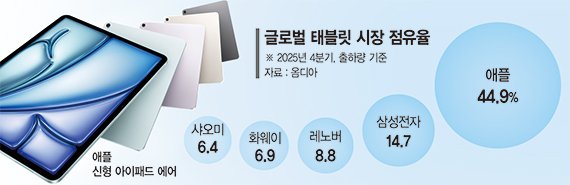
Recently, Apple released a new Apple iPad Air powered by its in-house Apple M4 chipset. The iPad Air, which features an 8-core central processing unit (CPU) and a 9-core graphics processing unit (GPU), delivers up to 30% better performance than the previous model equipped with the M3. Memory capacity has also increased to 12GB, 50% more than the earlier 8GB configuration. The starting price is set at 949,000 won for the 11-inch Wi-Fi model, a strategy seen as targeting a position between the base iPad and the Pro line. By freezing the base price to enhance price competitiveness while boosting performance, Apple appears to be aiming to broaden the appeal of its premium tablet lineup.
Samsung Electronics is also expected to configure its upcoming Samsung Galaxy Tab S12 series, due in the second half of this year, only with higher-end Plus and Ultra models. In fact, data from the International Mobile Equipment Identity (IMEI) database operated by the GSM Association (GSMA) show model numbers only for the Plus and Ultra variants. The absence of a standard model is being interpreted as a signal that Samsung is shifting its sales strategy toward large-screen, high-performance flagship tablets.
Huawei’s expansion constrained by U.S. sanctions
The tablet market began to retreat in the second half of last year. Chinese tablet makers with less than a 10% combined market share are relying on price competitiveness, but some players, including Huawei, are finding it difficult to gain traction in tablets due to the impact of U.S. sanctions.
Market research firm Counterpoint Research reported that global tablet shipments in the fourth quarter of last year fell 4% from a year earlier. The main reason cited is a base effect from the fourth quarter of 2022, when Samsung Electronics, Apple and Chinese manufacturers sharply increased shipments.
Another research firm, Omdia, found that Apple and Samsung held the top two spots in the tablet market in the fourth quarter of last year. Lenovo, Huawei and Xiaomi ranked third to fifth, respectively.
Unlike other brands in China, Huawei faces particular difficulty expanding its smartphones and tablets globally outside its home market. Because of U.S. sanctions, it cannot receive support for Google Mobile Services (GMS) and therefore cannot use Google Play. Another tablet maker, ZTE, was also sanctioned by the United States in 2018 for illegal transactions with North Korea and Iran. It is currently selling tablets with the Android operating system (Android OS) in parts of Europe.
Annual tablet shipments last year are estimated to have remained in the mid-100 million range, supported mainly by replacement demand. This year, however, sharp increases in memory prices are making retail price hikes unavoidable, and short-term demand weakness is expected. As a result, global manufacturers are likely to focus less on aggressively boosting shipment volumes and more on inventory management and profitability improvements to cut costs. In particular, the tablet lineup is expected to be reshaped around high-margin premium products, rather than low-end models with thin margins.
Sanghoon Kim, a researcher at Counterpoint Research, said, "The tablet market is entering a mature phase in which premium products and ecosystem competitiveness are becoming increasingly important," adding, "Major manufacturers are focusing less on short-term shipment races and more on strengthening long-term user experience and ecosystem competitiveness."
mkchang@fnnews.com Jang Min-kwon Reporter