"Memory Prices Will Soar in the Second Half"...How Much Will the Galaxy Z Fold 8 Go Up? [1-Day IT Item]
- Input
- 2026-03-18 06:00:00
- Updated
- 2026-03-18 06:00:00
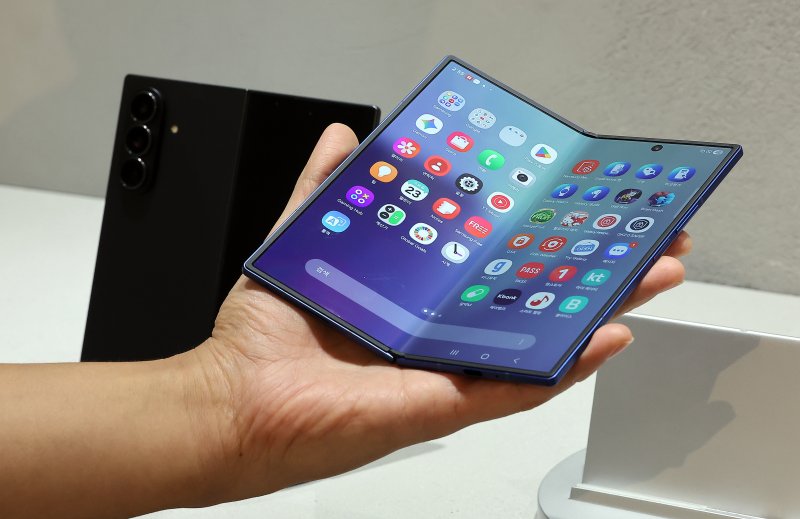
According to industry sources on the 18th, prices of foldable phones scheduled for release in the second half of this year are widely expected to rise across the board.
Overseas IT outlet MacRumors projected that the 256-gigabyte (GB) model of the Apple iPhone Fold will be priced at around 3.46 million won. That is nearly double the price of the 256GB "iPhone 17 Pro," which is expected to be about 1.79 million won. MacRumors also estimated that the 512GB model will cost around 3.9 million won, and the 1-terabyte (TB) version about 4.33 million won.
Samsung Electronics is also under pressure to raise prices for the Galaxy Z Fold 8 and Samsung Galaxy Z Flip 8. Last year, the 256GB model of the Samsung Galaxy Z Fold7 launched in Korea at 2,379,300 won, but due to soaring component costs, the launch price of the next-generation foldables is expected to climb sharply and could approach the 3 million won mark.
Earlier in February, Samsung Electronics also raised launch prices for its "Samsung Galaxy S26" series by about 100,000 to 300,000 won compared with the previous generation. Even with efforts to diversify its supply chain by using both Qualcomm’s "Snapdragon 8 Elite Gen 5" and its in-house "Exynos 2600" mobile application processors, and to minimize margins, the company could not fully absorb the jump in memory semiconductor prices.
With memory and other component prices soaring, smartphone manufacturers are struggling with deteriorating profitability.
Last year, Samsung Electronics spent 13.8272 trillion won on purchasing application processors, a 26.5% increase from 10.9326 trillion won the previous year.
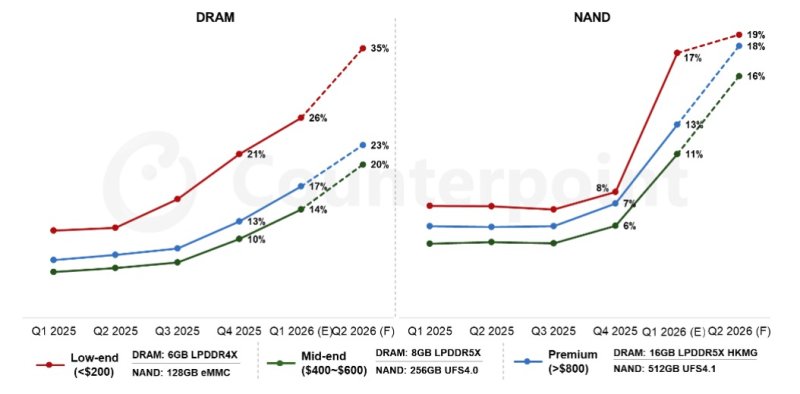
As DRAM and NAND flash prices continue to rise, cost pressures are mounting. Market research firm Counterpoint Research analyzed that, as of the second quarter of 2025, DRAM and NAND flash will account for about 23% and 18% of the bill of materials cost, respectively, in premium smartphones priced above 800 dollars.
According to DRAMeXchange, the average contract price in February for standard PC DRAM products (DDR4 8Gb 1Gx8) was 13.00 dollars, up 13.04% from 11.50 dollars a month earlier. The average price of Double Data Rate 4 Synchronous Dynamic Random-Access Memory (DDR4 SDRAM) has risen for 11 consecutive months since April 2025, when it stood at 1.65 dollars. In addition, the January average contract price for standard NAND flash products for memory cards and USB drives (128Gb 16Gx8 Multi-Level Cell (MLC) flash memory) was 12.67 dollars, a 33.91% increase from 9.46 dollars the previous month, marking 14 straight months of gains.
Shenghao Bai, a senior analyst at Counterpoint Research, stated, "With memory prices rising sharply, traditional cost-cutting measures alone may have limited impact," adding, "In 2026, increases in smartphone retail prices appear unavoidable, with budget models expected to go up by around 30 dollars and premium models by roughly 150 to 200 dollars."
mkchang@fnnews.com Jang Min-kwon Reporter