"Airfares to jump by 300,000 won in April" as fuel surcharges set to soar, likely boosting March ticketing
- Input
- 2026-03-18 04:00:00
- Updated
- 2026-03-18 04:00:00
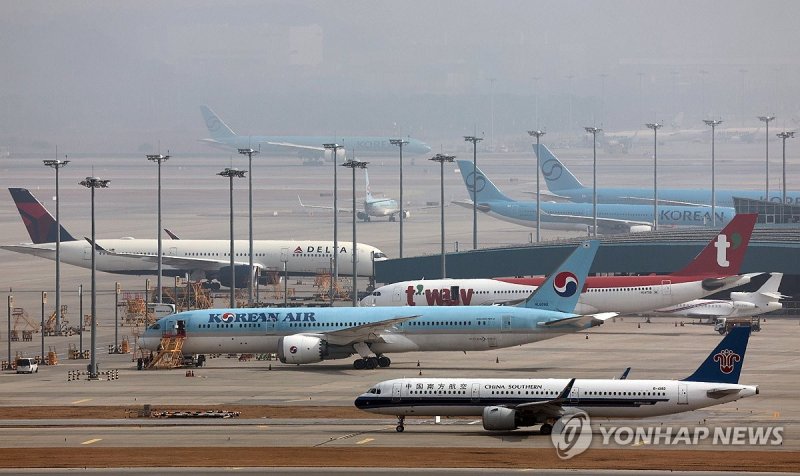
[Financial News] As the conflict in the Middle East drives up global oil prices and exchange rates, fuel surcharges on international air tickets for April are set to surge compared with the previous month.
According to the airline industry on the 18th, Korean Air’s fuel surcharges for international tickets issued on or after April 1 will range from 42,000 won to 303,000 won. The surcharge is set based on great-circle distance, the shortest route between two points on the earth’s surface. Compared with March tickets, which carried surcharges of 13,500 won to 99,000 won, routes with the shortest great-circle distance will see a 211% increase, while the longest-distance routes will rise by 206%.
The April fuel surcharge is calculated based on the average jet fuel price in Singapore, measured by Mean of Platts Singapore (MOPS), from February 16 to March 15 this year. During that period, jet fuel averaged 326.71 cents per gallon, or 137.22 dollars per barrel, placing it in level 18 out of 33 levels, which covers 320 to 329 cents per gallon.
In the previous month, level 6, corresponding to 200 to 209 cents per gallon, was applied. This means the level has jumped by 12 steps in just one month. It is the largest month-on-month increase since the current fuel surcharge system was introduced in 2016. It is also the highest level in three and a half years, since level 17 in October 2022, when global oil prices surged due to the Russo-Ukrainian War.
For Korean Air, routes with the shortest great-circle distance, such as Shenyang, Qingdao, Dalian, Yanji and Fukuoka, will carry a fuel surcharge of 42,000 won. Japan and China, which are the most popular destinations for Korean travelers, fall into the 500–999 mile band, where the surcharge has been set at 57,000 won, up 171% from last month. Routes in the 1,000–1,499 mile band, including Guangzhou and Xi’an, will see the surcharge rise to 78,000 won, an increase of 206%.
For medium- to long-haul routes, which mainly cover cities in Southeast Asia, the 1,500–1,999 mile band will have a surcharge of 97,500 won, up 225%. The 2,000–2,999 mile band will be set at 123,000 won, a 215% increase, and the 3,000–3,999 mile band at 126,000 won, up 200%.
In the 4,000–4,999 mile band, which includes the Middle East region, the fuel surcharge will be 199,500 won, up 209% from the previous month. Routes in the 5,000–6,499 mile band, which mainly cover Europe and the Western United States, will carry a surcharge of 276,000 won, while routes in the 6,500–9,999 mile band, including the Eastern United States, will be charged 303,000 won.
Asiana Airlines also announced that its fuel surcharges for next month will rise to between 43,900 won and 251,900 won. The increase rate for routes under 499 miles, the shortest great-circle distance band, is 201%, while routes over 5,000 miles, the longest band, will see a 220% increase.
Jin Air, which levies fuel surcharges in dollars, will raise its one-way surcharge from 8–21 dollars this month to 25–76 dollars next month, more than tripling the amount. Eastar Jet has likewise set its surcharge at 29–68 dollars, roughly three times higher than the previous month. Other low-cost carriers (LCC), including Jeju Air and T'way Air, plan to announce their fuel surcharges for next month within the coming days.
With fuel surcharges set to spike in April, some observers expect demand for ticket issuance to increase in March. Because the surcharge is determined by the ticketing date, there is a view that more travelers will try to issue tickets this month while the lower level still applies. Airlines do not collect additional charges if fuel surcharges rise after ticketing due to higher oil prices, nor do they refund the difference if surcharges later fall.
[email protected] Kim Hee-sun Reporter