"Amazing Samsung HBM4!", "Groq is super fast"...Nvidia CEO Jensen Huang signs wafers by hand
- Input
- 2026-03-17 10:49:09
- Updated
- 2026-03-17 10:49:09
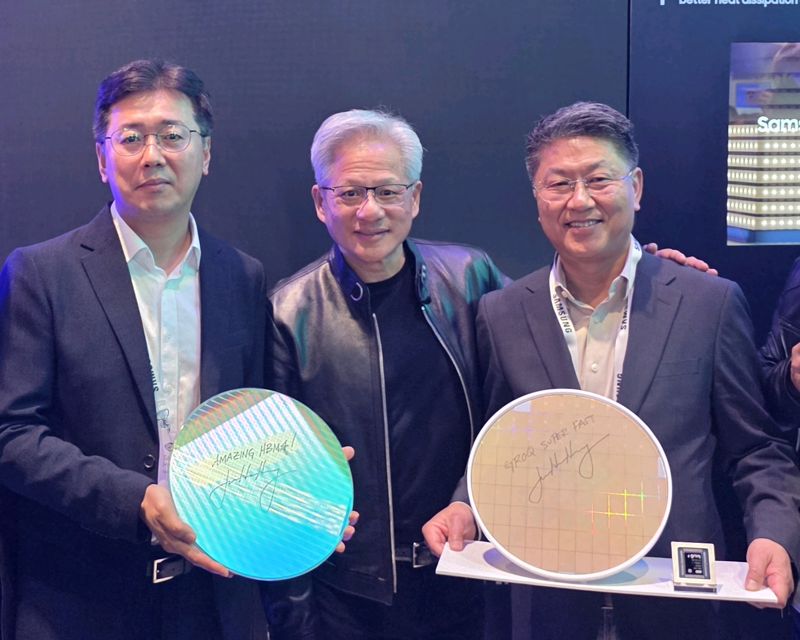
[Financial News] Nvidia CEO Jensen Huang visited the Samsung Electronics booth at the annual developer conference "NVIDIA GTC 2026 (NVIDIA GPU Technology Conference 2026)," which is being held in San Jose, California, for four days starting on March 16 (local time). Huang also posed for photos with Hwang Sang-jun, executive vice president for memory development at Samsung Electronics, and Han Jinman, president and head of the foundry business at Samsung Electronics.
On site, Huang left his handwritten signatures on a Samsung Electronics HBM4 core-die wafer and on a 4-nanometer foundry wafer for the company's new Groq language processing unit (LPU) inference chip. By doing so, he once again underscored the strong partnership between the two companies.
Earlier, during his GTC keynote, Huang introduced the inference-only chip and said, "Samsung is manufacturing the 'Groq 3' LPU chip for us," adding, "We are ramping up production as fast as we can right now. We are very grateful to Samsung." He went on to explain that this chip will be installed in Nvidia's next-generation artificial intelligence (AI) "Vera Rubin" system, and noted, "Shipments are expected to begin in the second half of this year, probably around the third or fourth quarter."
The Groq 3 LPU (Language Processing Unit) is designed to work alongside Nvidia's Rubin GPU architecture, sharing roles to boost inference performance and efficiency. Huang's remarks confirmed that Samsung Electronics' foundry business is producing this chip. As a result, Samsung Electronics can now showcase its collaboration with Nvidia not only in high-bandwidth memory (HBM) for Nvidia GPUs, but also in the foundry segment.
Samsung also placed exhibits highlighting its cooperation with Nvidia at the forefront of the booth. These included HBM4, which will be used in Nvidia's next-generation Rubin GPU architecture, as well as SOCAMM, a low-power memory module for servers for the NVIDIA Vera CPU, and the Samsung PM1763 enterprise SSD. Through these products, Samsung emphasized that it can supply all memory components for the NVIDIA Vera Rubin platform.
[email protected] Im Soo-bin Reporter