Ruling Party and Government Reach Deal on Indictment Agency Act After Turmoil, to Be Passed at Plenary Session on 19th
- Input
- 2026-03-17 10:24:39
- Updated
- 2026-03-17 10:24:39
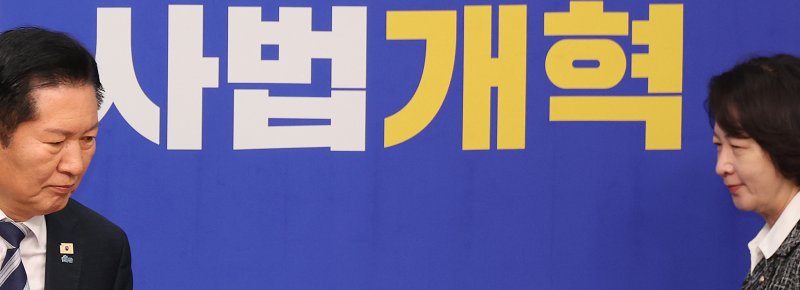
[The Financial News] The Democratic Party of Korea and the Lee Jae-myung administration on the 17th reached a compromise bill on establishing the Public Prosecution Office and the Serious Crime Investigation Agency (Serious Crimes Investigation Agency), after internal conflict. The agreement reflects many of the criticisms raised by the Democratic Party of Korea against the government’s original proposal. From the 17th to the 18th, they plan to change the party’s official position at a general meeting of lawmakers, pass the bill in the Legislation and Judiciary Committee of the National Assembly of the Republic of Korea and the Security and Public Administration Committee of the National Assembly, and then put it to a final vote at the plenary session of the National Assembly on the 19th.
At the National Assembly, Jung Chung-rae, leader of the Democratic Party of Korea, held an emergency press conference the same day. He stated, "The party, government and Cheong Wa Dae have quietly produced a unified agreement through close coordination," adding, "We have deleted and revised the toxic clauses that the public was deeply concerned about." He indicated that the bill is scheduled to be handled at the plenary session on the 19th.
Parliamentary leader Han Byung-do outlined the legislative timetable going forward. On the same day, they will change the party line at the general meeting of lawmakers and pass the compromise bill on the Public Prosecution Office and the Serious Crimes Investigation Agency in the bill review subcommittees of the Legislation and Judiciary Committee and the Security and Public Administration Committee of the National Assembly. On the 18th, the bill will be put to a vote in the full meetings of both committees. It is then scheduled for final passage at the plenary session of the National Assembly on the 19th.
Jung particularly stressed that the will of President Lee Jae Myung played a major role in reaching the agreement. He emphasized, "As the party has coordinated this, there is not the slightest disagreement among the party, government and Cheong Wa Dae, so I hope there will be no further controversy on this matter." His remarks were seen as reflecting President Lee’s recent warning about internal noise over Prosecution Reform during a dinner with first-term lawmakers.
Underscoring this point, the press conference was attended by Choo Mi-ae, who had led opposition to the government’s bill to establish the Public Prosecution Office, and executive secretary Kim Yong-min. Choo stated, "The party, the government and Cheong Wa Dae worked together in unity to reach this compromise. President Lee has always sought the right path through deliberation and debate, and Prosecution Reform is no exception." She went on, "This round of Prosecution Reform is a symbol of the Lee Jae-myung Popular Sovereignty Government, created through cooperation among the people, the party, the government and Cheong Wa Dae."
Executive secretary Kim Yong-min explained the contents of the agreement. First, the scope of prosecutors’ duties will be defined only by statute. This is intended to block any attempt to secure investigative powers through presidential decrees. The Serious Crimes Investigation Agency’s obligation to notify the Public Prosecution Office when opening a case, as well as prosecutors’ powers to request case openings and to submit opinions, and their authority to direct and supervise special judicial police, have all been removed. The aim is to prevent the Serious Crimes Investigation Agency from effectively functioning as a subordinate body of the Public Prosecution Office.
To prevent prosecutors at the Public Prosecution Office from intervening in investigations, the agreement also deletes their authority to direct the request and execution of warrants, to order investigations suspended, and to demand that officials be removed from duty. The provision that allowed the Prosecutor General of South Korea to direct all prosecutors nationwide through delegation and succession of duties has been removed, and that authority is now vested in the head of the Public Prosecution Office to which each prosecutor belongs. In addition, the period for handling existing cases will be shortened from six months to 90 days, and a legal basis has been created for the government to take the lead in allocating personnel between the Public Prosecution Office and the Serious Crimes Investigation Agency.
The bill on the Serious Crime Investigation Agency is already under negotiation between the ruling and opposition parties in a subcommittee of the Security and Public Administration Committee of the National Assembly, after the party and government reached a broad consensus. In the final stage of the agreement, however, the scope of investigations—six major categories of crime—was specified in detail, article by article. As Kim explained, the provisions requiring the agency to receive notifications and requests for case openings from the Public Prosecution Office were deleted.
Jung argued, "The prosecution has appeared competent because it held all the powers—initiating, directing and closing investigations, as well as requesting and executing warrants—while the police, which did not have such powers, appeared incompetent." He continued, "We must break that fixed idea. It is a misguided prejudice."
However, the agreement on Prosecution Reform does not mean the reform package is complete. Remaining issues, including whether to grant the Public Prosecution Office supplementary investigative powers—the most contentious point—must be resolved through amendments to the Criminal Procedure Act of the Republic of Korea. For this reason, executive secretary Kim also stressed that revising the Criminal Procedure Act would be the final step in the process.
[email protected] Yoonho Kim, Reporter Reporter