Jensen Huang says Nvidia could reach $1 trillion in revenue by 2027: Is its AI empire now secure?
- Input
- 2026-03-17 09:55:35
- Updated
- 2026-03-17 09:55:35
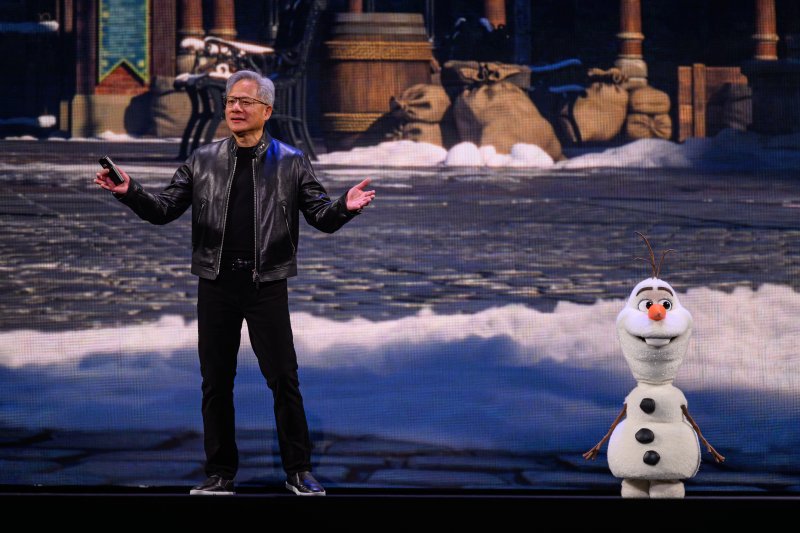
The Financial News reported that Nvidia, riding the explosive growth of the artificial intelligence (AI) industry, has unveiled an ambitious roadmap to dramatically expand its revenue over the next three years.
On the 16th (local time), business news channel CNBC reported that Nvidia CEO Jensen Huang, in his keynote at the annual developer conference NVIDIA GPU Technology Conference 2024 (NVIDIA GTC 2024) in San Jose, California, projected that orders for its next-generation graphics processing unit (GPU) NVIDIA Blackwell architecture and its successor, the NVIDIA Vera Rubin platform, could reach $1 trillion (about 1,492 trillion won) by 2027. This is double last year's forecast of $500 billion, the report noted.
Nvidia currently has a market capitalization of about $4.5 trillion (around 6,715 trillion won), making it the most valuable publicly traded company in the world. Huang said, "Demand is surging from both startups and large enterprises," adding that as AI evolves beyond simple chatbots into "agentic apps" that can carry out tasks autonomously, the volume of tokens, the basic unit of data processing, is increasing exponentially.
He stressed the importance of inference speed and efficiency, saying, "The more computing capacity you have, the more tokens you can generate, and that directly translates into higher revenue."
The NVIDIA Vera Rubin platform system, scheduled for release at the end of this year, will be made up of an astonishing 1.3 million components.
Nvidia said this system delivers 10 times better performance per watt than the previous Grace Blackwell platform. The company expects it to become a key solution to the power consumption problem, one of the biggest bottlenecks in building AI infrastructure.
Huang also unveiled the Groq 3 Language Processing Unit (LPU), which incorporates technology from Groq, the startup Nvidia acquired for $2 billion last December.
Nvidia that day also showcased a prototype of its next architecture after Rubin, called Kyber.
This design vertically stacks 44 GPUs to increase density and sharply reduce latency. It is slated to be used in the NVIDIA Rubin Ultra platform, which is scheduled for launch in 2027.
On the software side, Nvidia announced NemoClaw, a developer toolkit to support OpenClaw, a fast-rising autonomous AI project for task execution. The goal is to help companies more easily build open-source-based AI agents on Nvidia hardware.
In the automotive segment, Huang provided more details on a previously announced partnership with Uber, saying Uber plans to deploy autonomous vehicles powered by NVIDIA DRIVE AV software in Los Angeles and San Francisco starting next year, and to expand to 28 cities across four continents by 2028.
Huang added that Hyundai Motor Company, Nissan Motor, Isuzu Motors, China's BYD and Geely Automobile are developing Level 4 autonomous vehicles based on the NVIDIA DRIVE Hyperion autonomous driving platform.
[email protected] Reporter Yoon Jae-joon Reporter