Fed puts rate cuts on hold...Will the Bank of Korea also freeze its policy rate?
- Input
- 2026-03-17 10:51:32
- Updated
- 2026-03-17 10:51:32
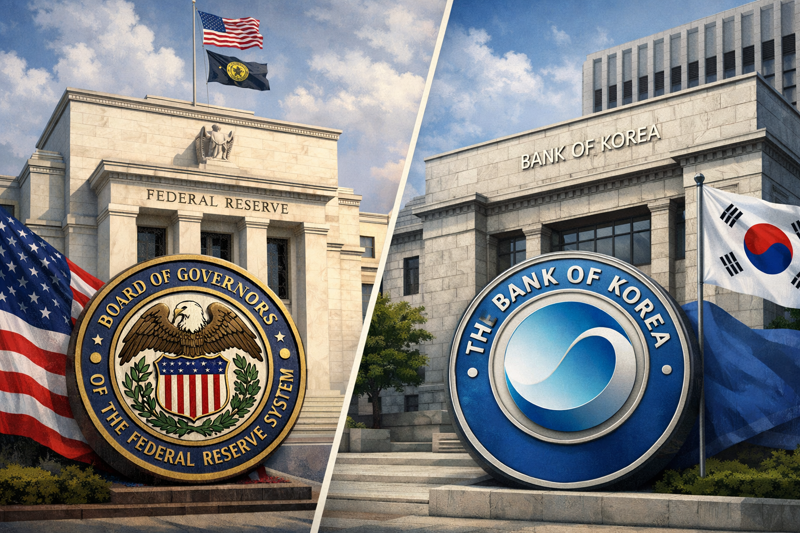
According to the CME FedWatch Tool, which is based on data from the Chicago Mercantile Exchange (CME), an analysis of trading behavior in U.S. policy rate futures as of the 16th (local time) shows a 99.1% probability that the Federal Open Market Committee (FOMC) will keep the federal funds target range unchanged at 3.50–3.75% at its meeting on the 18th. The probability of a rate cut is just 0.9%.
The likelihood of a hold has risen sharply in recent weeks. On March 13, about a month earlier, the probability of no change stood at 90.8%. It climbed to 98.3% by the 9th of this month, and then increased by another 0.8 percentage point within a week.
This trend is expected to persist through the end of the year. Across the remaining six FOMC meetings this year, excluding this month, the chances of a rate cut appear limited. From April through June, July, September, and October, the probability of keeping rates at the current level gradually declines, but it still exceeds the odds of a cut.
The first point at which expectations for a cut slightly overtake those for a hold appears at the final FOMC meeting in December. However, if the Middle East conflict drags on, that balance could easily shift back in favor of another hold. Fed Funds Futures for December settlement, which are based on the federal funds rate, are currently trading at 96.59. This implies that the market expects the average policy rate that month to be around 3.41%, only marginally below the current level.
Against this backdrop, the Monetary Policy Board of the Bank of Korea, which is scheduled to meet in April, now faces an environment in which it is effectively compelled to keep its benchmark rate unchanged. The main constraint is the US Dollar–South Korean Won exchange rate, which is hovering around the 1,500-won mark. If the BOK cuts rates and widens the interest-rate gap with the U.S., capital could flow into dollar assets, further weakening the won.
Moreover, the BOK has completed revisions to its General Principles for the Operation of Monetary and Credit Policy to explicitly add a commitment to "efforts to stabilize the foreign exchange market." This means it is now formally required to take the exchange rate and related factors into account.
In the Monetary and Credit Policy Report released on the 12th, Hwang Geon-il, a Member of the Monetary Policy Board of the Bank of Korea, conveyed the Board’s message that "going forward, rather than fostering expectations in a particular policy direction, it would be desirable to maintain a cautious neutral stance for the time being while monitoring changes in domestic and external conditions and economic indicators."
In practical terms, this suggests that adjusting the benchmark rate will be very difficult. A premature rate cut could stoke inflation at a time when international oil prices are surging, while a rate hike would increase the burden on borrowers who have taken out loans to purchase housing.
Financial markets have already priced in some of this "hawkish" outlook for both the Fed and the BOK. The yield on the 10-year U.S. Treasury note has already climbed above 4.2%. The yield on the 3-year Korean Treasury bond, which stood at 3.041% on February 27, the day before the Middle East conflict erupted, had risen to 3.300% as of the 16th, an increase of 25.9 basis points.
At the February meeting of the Monetary Policy Board, the BOK for the first time introduced a six-month conditional benchmark rate outlook in the form of a forward guidance dot plot. Of the 21 dots, 16 were placed at the current level of 2.50%, while four pointed to 2.25%, indicating a cut. If the end of the Middle East conflict is pushed back, those dots signaling cuts are expected to disappear in the next dot plot to be released in May.
That said, the deterioration in U.S. labor market data provides some justification for eventual rate cuts. Nonfarm payrolls in February fell by 92,000 from the previous month, and the unemployment rate rose from 4.3% in January to 4.4% in February.
[email protected] Kim Tae-il Reporter