Won-Dollar Rate Briefly Tops 1,500 During Trading, Highest Since Financial Crisis
- Input
- 2026-03-16 18:31:47
- Updated
- 2026-03-16 18:31:47
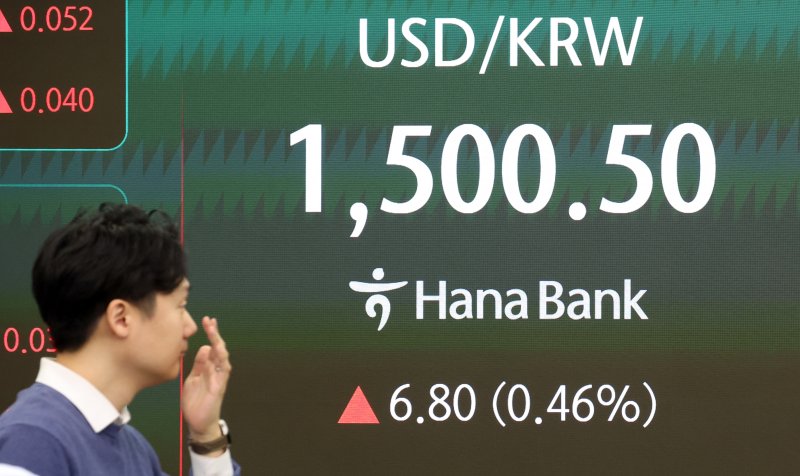
On the 16th, the won-dollar rate in the Seoul Foreign Exchange Market closed weekly trading at 1,497.5 won, up 3.8 won from the previous day. This is the highest level in about 17 years and 4 months, since November 25, 2008, during the financial crisis, when it reached 1,502.3 won. It also surpassed, after just one week, the closing level of 1,495.5 won recorded on the 9th, when international oil prices first climbed above 100 dollars per barrel.
The rate opened the day at 1,501.0 won per dollar, 7.3 won higher than the previous close. The fact that it broke through 1,500 won during intraday trading is also a first in 17 years, since March 12, 2009, in the financial crisis, when the intraday high reached 1,500 won.
The latest spike in the exchange rate is widely seen as the result of investors flocking to the dollar, the representative safe-haven asset, amid the turmoil in the Middle East. The U.S. Dollar Index (DXY), which measures the dollar against six major currencies, had already climbed above 100 on the 13th.
A surge in international oil prices driven by the prolonged Middle East crisis is also weighing on the won. South Korea imports about 80 percent of its crude oil from the Middle East, and all of it is paid for in dollars. When oil prices rise, the country must spend more dollars to buy the same amount of oil, increasing dollar demand and pushing up its value while driving down the value of the won.
If the situation in the Middle East drags on, inflation could become a real concern. From the perspective of the Federal Reserve System (the Fed), it would have little choice but to prioritize taming inflation, which could put interest rate hikes back on the table. In that case, global capital would flow into dollar assets, boosting the currency’s value and putting renewed upward pressure on the won-dollar exchange rate.
Selling by foreign investors in the stock market is another factor. On the day, foreign investors recorded net sales of 847.5 billion won in the Stock Market Division of the Korea Exchange.
[email protected] Kim Tae-il Reporter