President Lee backs Prosecution Reform but says, "It is hard to accept renaming the Prosecutor General of South Korea as the Head of the Public Prosecution Service"
- Input
- 2026-03-16 18:21:48
- Updated
- 2026-03-16 18:21:48
Lee delivered this message in a post titled "Concerns in some quarters about Prosecution Reform are unfounded" on X (formerly Twitter) the same day. In particular, he argued, "It is difficult to understand why we must go so far as to change the title of the Prosecutor General of South Korea to the Head of the Public Prosecution Service, thereby leaving room for constitutional challenges and giving grounds and opportunities for a counterattack."
He also wrote, "The core of Prosecution Reform is to separate investigation and indictment and to exclude prosecutors from investigative powers," adding, "The people’s-sovereignty government has a clear policy that, through Prosecution Reform, prosecutors will neither conduct direct investigations nor intervene in investigations by other investigative bodies beyond the powers stipulated in the Constitution, such as requesting warrants."
Within the Democratic Party of Korea, lawmakers Choo Mi-ae, who chairs the Legislation and Judiciary Committee, and Kim Yong-min, the ruling party’s secretary on the committee, are regarded as hardliners on Prosecution Reform. They have criticized the government proposal as a "return to the old Prosecutors' Office" bill and had called for revisions. Observers see Lee’s remarks as signaling his intention to settle internal disagreements and push for swift legislation.
Earlier in the day, Kang Jun-hyun, chief spokesperson for the Democratic Party of Korea, said after a meeting of the party’s Supreme Council, "We do not rule out the possibility that the Serious Crimes Investigation Agency Act and the Indictment Agency Act could be passed as early as the 19th. We are coordinating their handling, and if that proves difficult, we are aiming for passage during the March session of the National Assembly." Kim Hyun-jung, the party’s floor spokesperson, said on Korean Broadcasting System (KBS) radio the same day, "At last night’s dinner, the president emphasized the shared responsibility of the government and the ruling party," and added, "The government bills on the Serious Crimes Investigation Agency and the Public Prosecution Office have already been adopted as the party’s official position. We now need to quickly complete the legislation."
Lee stated, "The separation of investigation and indictment and the exclusion of prosecutors from investigations have already been finalized as national policy tasks and are irreversible," and continued, "Whether the head of the Public Prosecution Office is called the Prosecutor General of South Korea, as stipulated in the Constitution, or the Head of the Public Prosecution Service, and whether all prosecutors are dismissed and selectively reappointed, are matters that are not directly related to the separation of investigation and indictment (the exclusion of prosecutors from investigations)."
He went on, "We need to recall the historical experience in which, because of excess, we missed a decisive opportunity for reform and ultimately allowed the return of vested interests," and explained, "Although the government bill has been pre-announced for legislation, the party and the government produced a revised draft through policy consultations, and this draft was adopted as the ruling party’s official position. This draft is therefore not simply a government bill but a party–government consultation proposal. Even this proposal is not an immutable final version; if necessary, it can be further discussed and amended during the legislative process."
He added, "However, any such further revision must help to uphold the overarching principle of separating investigation and indictment and excluding prosecutors from investigations. Under no circumstances should it be driven by someone’s desire to appear more hardline or by other objectives unrelated to the essence of Prosecution Reform."
Lee also wrote, "The Constitution designates prosecutors as the subjects of prosecutorial affairs and the Prosecutor General of South Korea as the person with overall responsibility for them, so it is only natural that the institution in charge of prosecutorial affairs is called the Prosecutors' Office. After we changed the name of the Prosecutors' Office to the Public Prosecution Office, to now insist that the Prosecutor General of South Korea be renamed the Head of the Public Prosecution Service and prosecutors be called public prosecutors is going too far," adding, "We will push ahead with Prosecution Reform, a clear national policy task of this government, namely the separation of investigation and indictment and the exclusion of prosecutors from investigations, without the slightest wavering. At the same time, when we are fundamentally restructuring the national governance system, which concerns the lives of the people and the country’s long-term future, there must not be even the smallest gap or flaw."
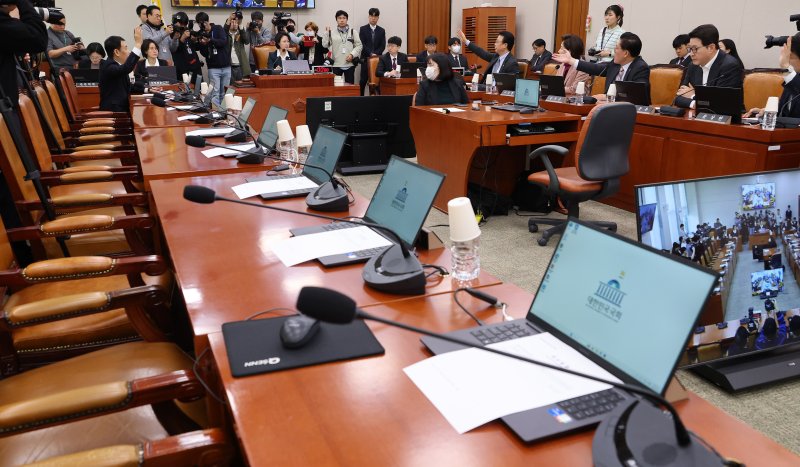
However, at the plenary session of the Legislation and Judiciary Committee held that day, Committee Chair Choo Mi-ae and Kim Yong-min, the Democratic Party of Korea’s secretary on the committee, did not issue any separate statement regarding President Lee’s request conveyed through Cheong Wa Dae (the Blue House). A public hearing on the Indictment Agency Act is scheduled for the 20th. Despite behind-the-scenes coordination between the party’s floor leadership and the committee, expectations are growing that it will in fact be difficult to bring the government’s Serious Crimes Investigation Agency Act and Indictment Agency Act to a vote at the plenary session on the 19th.
[email protected] Choi Jong-geun, Song Ji-won Reporter