Bitcoin Breaks Through Middle East Risk, Reclaims $73,000 Level...‘Digital Gold’ Put to the Test [Crypto Briefing]
- Input
- 2026-03-16 14:39:46
- Updated
- 2026-03-16 14:39:46
According to Financial News, Bitcoin has pushed through extreme volatility triggered by geopolitical risks from the Middle East and has reclaimed the $73,000 level. As concerns grow over a possible blockade of the Strait of Hormuz and oil prices surge past $100 per barrel, Bitcoin had fallen into the mid-$65,000 range. Analysts say, however, that demand for risk hedging, including as an inflation hedge, has flowed in and driven a rapid rebound. Experts argue that Bitcoin is moving beyond the profile of a typical risk asset and is once again being tested against its “digital gold” narrative.
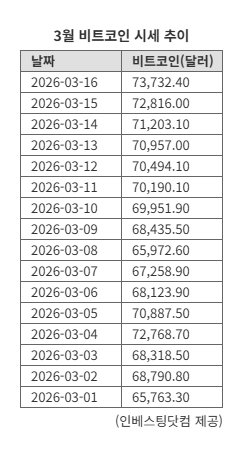
On the 16th, global financial information platform Investing.com showed Bitcoin trading at $73,732. This represents a 1.26% rise over the previous day on a 24-hour basis. Compared with the low of $65,763 on the 1st, the price has climbed about 12% so far this month.
Domestic market indices have also been strong. The Upbit Composite Index (UBMI) rose 8.04% from a week earlier to 11,050.25. In particular, the artificial intelligence sector gained 29.91%, while the modular blockchain sector advanced 11.42%, suggesting that the altcoin market is heating up alongside Bitcoin’s rise.
Market participants are largely attributing the recent rebound to Bitcoin’s limited supply. Of the total possible supply of 21 million Bitcoins, more than 20 million have already been mined, which many see as reinforcing downside rigidity. Kim Ji-won of KB Securities noted, “Even though there was a net outflow of about $50 million from institution-focused spot Bitcoin exchange-traded funds (ETFs), the share of net selling by long-term holders has decreased.”
Shin Seung-yoon at LS Securities likewise stated, “The fact that more than 95% of all Bitcoins have already been mined is evidence supporting the historical halving cycle.” In the short term, Bitcoin is showing a high correlation with the Nasdaq Stock Market (Nasdaq). However, if gold prices rise in the second half of the year, many expect Bitcoin to move in tandem.
Even so, there is still considerable caution about how to classify Bitcoin’s true nature. When oil prices recently broke above $100, Bitcoin moved in lockstep with the Nasdaq and weakened alongside it. Analysts say this pattern indicates that Bitcoin remains a risk asset highly sensitive to shifts in liquidity.
In fact, Upbit’s Fear and Greed Index stood at 51 as of Monday morning, signaling a “neutral” market. The reading is up 14 points from a week earlier, showing some recovery in sentiment, but it also suggests that investors remain cautious as they watch geopolitical risks and oil price volatility.
A source in the virtual asset industry commented, “With the risk of military conflict surrounding the Islamic Republic of Iran on the rise, whether Bitcoin will trace a path similar to gold or plunge like tech stocks will determine how quickly it is incorporated into the mainstream asset universe.” The source added, “For the time being, it is highly likely that Bitcoin will continue to fluctuate within a box range in the low $70,000s in line with oil price movements.”
elikim@fnnews.com Kim Mi-hee Reporter