‘Kedehun’ Scores Two Wins at the Oscars
- Input
- 2026-03-16 15:31:50
- Updated
- 2026-03-16 15:31:50
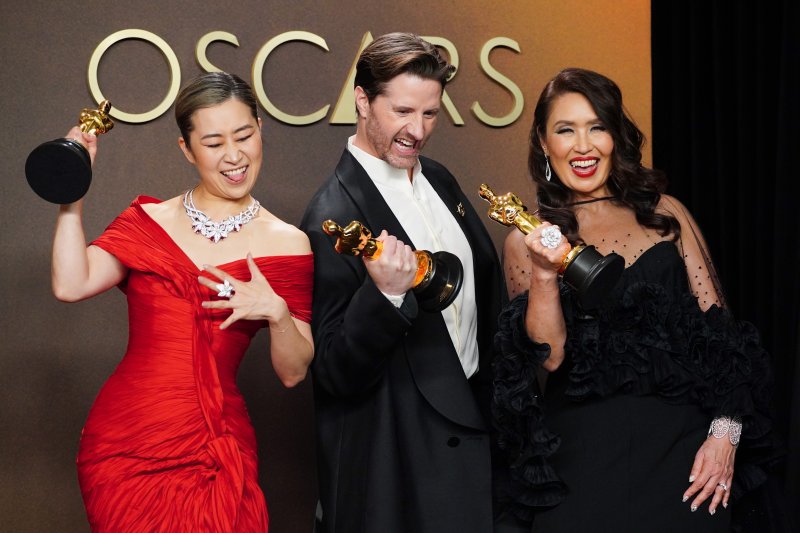


[Financial News] "This award is for Korea and for Koreans all around the world."
The animated film "KPop Demon Hunters," the most-watched animated movie on Netflix, has capped its global run by adding two Oscars to its Golden Globe Awards and Grammy Awards wins, cementing its status as a full-blown phenomenon. At the 98th Academy Awards (the Oscars), held on the 15th (local time) at the Dolby Theatre in Los Angeles, Kedehun won both Animated Feature Film and Original Song. It beat out heavyweight contenders such as The Walt Disney Company’s "Zootopia 2" and Pixar Animation Studios’ "Elio" to take home the trophies. The film has become a symbolic example of an animation centered on K-culture winning major awards.■ Asian Creators Step Into the SpotlightWearing a red dress, director Maggie Kang took the stage and said, "I am truly sorry that it took so long for people who look like me to see a movie like this on the big screen." She continued, "But now a film like this exists. The next generation will no longer have to wait." She shared the joy of the win with Korea and Koreans around the world.
Co-director Chris Appelhans remarked, "Music and storytelling have the power to connect us beyond cultures and borders," sending a message of encouragement to creators everywhere. He added, "To young filmmakers, artists, and musicians, I want to say this: tell your stories. Sing with your own voice. The world is waiting for you."
Producer Michelle Wong, who set a new milestone for women producers through the commercial and critical success of Kedehun, also joined them on stage that night.
The original soundtrack "Golden" from Kedehun won the Oscar for Best Original Song. It is the first time a K-pop song has received the Original Song award at the Oscars. EJAE, the singer and co-lyricist and co-composer of "Golden," broke into tears and said, "This song is not about success; it is about healing." She recalled, "When I was young, people made fun of me for liking K-pop, but now everyone is singing our song. I am so proud."
The win carries even greater meaning because EJAE once spent more than 10 years training to become a K-pop idol, only to see that dream collapse, and has now fulfilled it in a different way. Co-lyricist Mark Sonnenblick and composers Gwak Jung-gyu, Lee Yu-han, Nam Hee-dong (IDO), and Seo Jung-hoon from The Black Label joined her on stage to share the moment. However, due to time constraints, their acceptance speeches were cut short, leaving some disappointment.■ K-pop Lightstick Culture Takes Over the Oscars StageForeign media outlets also reported on the victories of Kedehun and "Golden," highlighting their cultural significance. The Guardian and others noted that K-pop has extended its influence beyond the music industry to the heart of Hollywood’s film awards, and reported that "EJAE, IDO, and Teddy have become the first Koreans to win in this category."
Reuters described Kedehun’s win as "a historic moment in which diversity and cultural representation are expanding in the animation industry." Commentators said it was a symbolic event that showcased the growing presence of Asian creators.
EJAE also took part in a special performance with Audrey Nuna and Rei Ami, who appear as members of the in-film girl group Huntrix in Kedehun. In keeping with Korea’s traditional affinity for white clothing, the three wore white dresses on stage. Twenty-four dancers, including percussionists, added a distinctly Korean flair to the performance in white outfits while waving yellow flags. In the audience, Hollywood stars such as Emma Stone, Gwyneth Paltrow, and Leonardo DiCaprio were seen waving lightsticks, creating an extraordinary scene. It was as if K-pop’s fan culture had been transplanted directly onto the Oscars stage.
Jaewon Lee, a visiting professor in the Culture and Technology Convergence Major at Sungkyunkwan University (SKKU), said, "The wins for Kedehun and Golden, both rooted in K-pop, along with BTS’s Gwanghwamun concert being broadcast live worldwide on Netflix, show K-pop’s current status." He added, "K-pop is no longer a niche taste for a small group of fans; it has become part of the mainstream global music market. Since the Oscars and Netflix still hold dominant power in the global content industry, these achievements suggest that K-pop’s reach will continue to expand."
Meanwhile, "Bugonia," a remake of the Korean film "Save the Green Planet!," was nominated in four categories, including Best Picture and Best Actress, but went home empty-handed. The coveted Best Picture award went to Paul Thomas Anderson’s "One Battle After Another." The film took a total of six trophies, including Best Picture, Best Director, Best Supporting Actor, as well as Best Adapted Screenplay, Best Editing, and Best Casting.
jashin@fnnews.com Shin Jin-ah Reporter