Sham divorces to avoid Basic Pension cuts? Government to gradually reduce benefit reduction rate for couples from next year
- Input
- 2026-03-16 12:10:28
- Updated
- 2026-03-16 12:10:28
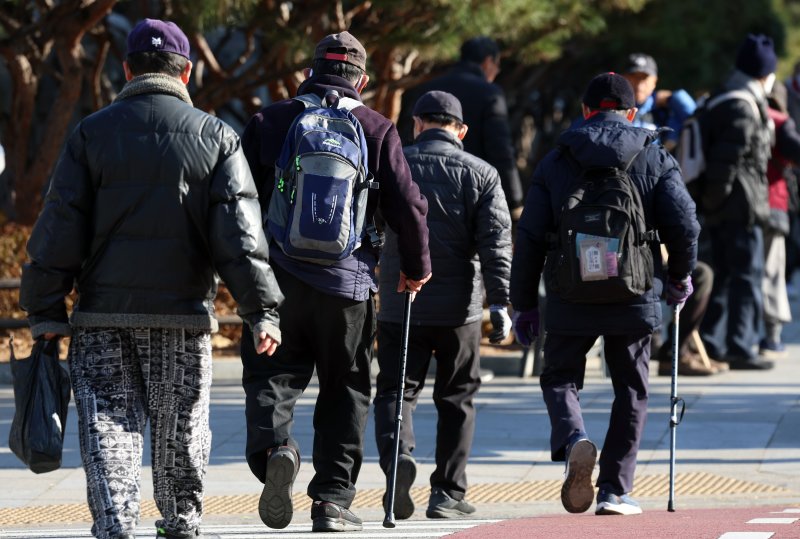
[Financial News] Starting in 2027, the government plans to gradually lower the reduction rate applied to elderly couples receiving the Basic Pension, beginning with low-income households. The aim is to fill income gaps among vulnerable seniors and secure their real retirement income as the country enters a super-aged society.
According to the Health and Welfare Committee of the National Assembly on the 16th, the Ministry of Health and Welfare reported this policy direction as part of its key work progress at a full session of the Standing Committee of the National Assembly held on the 10th.
The Ministry of Health and Welfare presented measures to expand the coverage of the existing pension system. Under the current scheme, when both spouses in a couple aged 65 or older and in the bottom 70% income bracket receive the pension, each person’s benefit is reduced by 20%.
However, a study by the National Pension Research Institute found that consumption spending by poor couples in the bottom 20% income bracket is 1.74 times that of single-person households, exceeding the system’s benchmark of 1.6 times. This has fueled criticism that a 20% reduction is excessively harsh for low-income couples and directly leads to severe financial hardship.
In response, the ministry’s plan submitted to the National Assembly calls for lowering the current 20% reduction rate to 15% by 2027 for elderly couples in the bottom 40% income bracket, and then gradually cutting it further to 10% by 2030.
In the political establishment, a bill has also been introduced to completely abolish the couple reduction rule over three years. President Lee Jae-myung has likewise argued that reforming the Basic Pension is necessary to address elderly poverty, which in some cases leads to suicide, so changes to the system are expected to accelerate.
On the same day, President Lee wrote on a social networking service (SNS), "It should not be a disadvantage for a couple to stay married until the end of their lives. I hear there are even cases of sham divorces just to avoid Basic Pension reductions," adding, "Since reduced payments are due to a lack of fiscal resources, they should be corrected as much as possible."
Lee also noted, "The Basic Pension amount is the same for seniors who earn several million won a month and for those with zero income," and continued, "Now we could afford to be a bit more generous to poor seniors. One option might be to leave current payments as they are and apply larger increases to low-income seniors and smaller increases to those with higher incomes in the future."
However, the massive fiscal cost of such reforms remains a key challenge. According to an analysis by the National Assembly Budget Office (NABO), if the couple reduction rule is phased out, an additional 16.7 trillion won will be needed over five years through 2030, or about 3.3 trillion won per year.
In light of this, the Ministry of Health and Welfare is reportedly planning to draw up a detailed implementation plan that takes into account fiscal burdens and international examples.
[email protected] Seo Young-jun Reporter