"They say I'm dead" vs. "I'm still alive": Middle Eastern leaders forced to prove they’re alive amid AI rumors [Kim Kyung-min’s Timely Hit]
- Input
- 2026-03-16 10:36:30
- Updated
- 2026-03-16 10:36:30

According to The Financial News, the leaders of the two main pillars of the Middle East, the Islamic Republic of Iran and the State of Israel, have moved to prove they are alive in order to dispel rumors that they had died or were in poor health. As rival camps used artificial intelligence (AI) tools and unverified information to treat the leaders’ absence as a fait accompli, a bizarre spectacle has unfolded in which the leaders themselves appear in public or issue statements to respond. In a situation where a leader’s survival is directly tied to national security, a propaganda war has emerged that combines deepfake technology with information warfare by hostile states.
On the 15th (local time), Netanyahu posted on social media a video of himself visiting a café in the suburbs of Jerusalem, showcasing that he is in good health.
Recently, an online rumor spread that a speech video of Netanyahu released on the 13th was AI-generated and that he was actually dead, because his right hand in the footage appeared to show six fingers.
In response, Netanyahu directly confronted the death rumors with a video of himself drinking coffee in the café and answering his aide in Hebrew, "I love coffee to death. You know that? And I love our people to death." In the video, he opens his fingers one by one to demonstrate that the footage is not an AI manipulation. The Associated Press (AP) and other foreign media confirmed his visit through other posts from the same café.
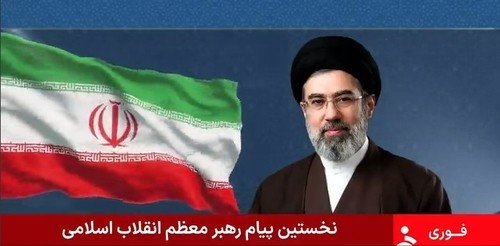
By contrast, Mojtaba Khamenei, the new supreme leader of the Islamic Republic of Iran, has fueled suspicion by adopting a reclusive approach. After succeeding to power following the death of his father, Ali Hosseini Khamenei, he has not appeared in public even once since taking office, issuing messages only in written form.
In an interview with National Broadcasting Company (NBC), U.S. President Donald Trump directly attacked him, saying, "I have heard that he is not alive. If he is alive, he should surrender." U.S. Defense Secretary Pete Hegseth also launched an intense psychological offensive by raising the possibility that Mojtaba’s appearance had been disfigured.
The government of the Islamic Republic of Iran immediately pushed back. Foreign Minister Abbas Araghchi said in an interview with Al-Araby Al-Jadeed, "The supreme leader is in very good health and is in complete control of all situations."
Mojtaba Khamenei also hardened his stance in a written statement, vowing, "I will carry out bloody revenge against the United States and the State of Israel," but with no visual evidence at all, speculation about the safety of the man known as "the Janbaz of Ramadan" (a "wounded warrior") has not died down.
As uncertainty over the leaders’ status grows, moves to exploit a potential power vacuum have also gathered pace. Reza Pahlavi, crown prince and heir to the Pahlavi monarchy that was overthrown in the 1979 Islamic Revolution, declared on the 14th via X (formerly Twitter), "I am ready to immediately take charge of running the country if the Islamic Republic of Iran collapses," saying he had spent months identifying talent at home and abroad and had completed forming a transitional governing structure.
[email protected] Kim Kyung-min Reporter