Is Deploying Ground Troops the Answer? The Strait of Hormuz Stalemate and America’s Dilemma
- Input
- 2026-03-16 09:51:24
- Updated
- 2026-03-16 09:51:24
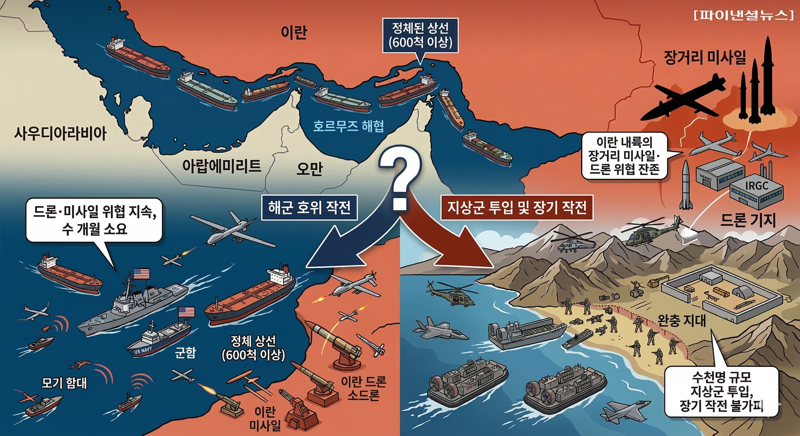
According to the Financial News, although U.S. President Donald Trump has declared that he will lift the blockade of the Strait of Hormuz, some analysts argue that securing the actual sea lanes may ultimately require the deployment of United States Armed Forces (U.S. military) ground troops and a prolonged military campaign. They assess that simple naval escort missions will not be enough to neutralize the Islamic Republic of Iran’s missile and drone threats.
On the 15th (local time), The Wall Street Journal (WSJ) reported that the Trump administration is reviewing a range of military options, including escorting ships through the Strait of Hormuz, applying military pressure along the Iranian coast, and even seizing control of the shoreline. However, any option is expected to entail significant risks and costs.
Trump and Defense Secretary Pete Hegseth recently indicated that the U.S. Navy could escort oil tankers and other commercial vessels as they pass through the Strait of Hormuz. Trump has also asked major countries such as South Korea, China, Japan, the United Kingdom (UK), and France to dispatch warships.
Inside the U.S. military, however, there is said to be considerable concern about the risks of such operations. The Strait of Hormuz is only about 34 kilometers wide at its narrowest point, meaning that a concentration of warships could be highly vulnerable to attack.
The most direct military option would be for the U.S. Navy and allied navies to form convoys of tankers and escort them through the strait. In that scenario, they would have to clear naval mines while simultaneously defending against attacks by drones and small high-speed boats, the so-called “mosquito fleet” of the Islamic Republic of Iran.
Although the Islamic Republic of Iran’s military capabilities are believed to have suffered significant damage from recent U.S. and Israeli airstrikes, it is still assessed to retain a meaningful level of offensive power.
Bryan Clark, a senior fellow at the Hudson Institute and a former naval officer, analyzed the situation by saying, "To protect U.S. naval forces at sea, at least 10 General Atomics MQ-9 Reaper drones would need to be on constant patrol to detect and strike Iranian missile and drone launchers."
Even if convoy operations are carried out in this way, their effectiveness may be limited. It is reported that around 600 commercial vessels are currently stuck in the Gulf region. Experts believe that, even with organized convoys, it could take several months to clear this backlog.
Even if airstrikes and naval defense operations succeed in establishing control over the area around the Strait of Hormuz, the risk of missile and drone attacks from the Islamic Republic of Iran would remain. It would be extremely difficult to eliminate entirely the possibility that warships or commercial vessels could be hit by surprise attacks.
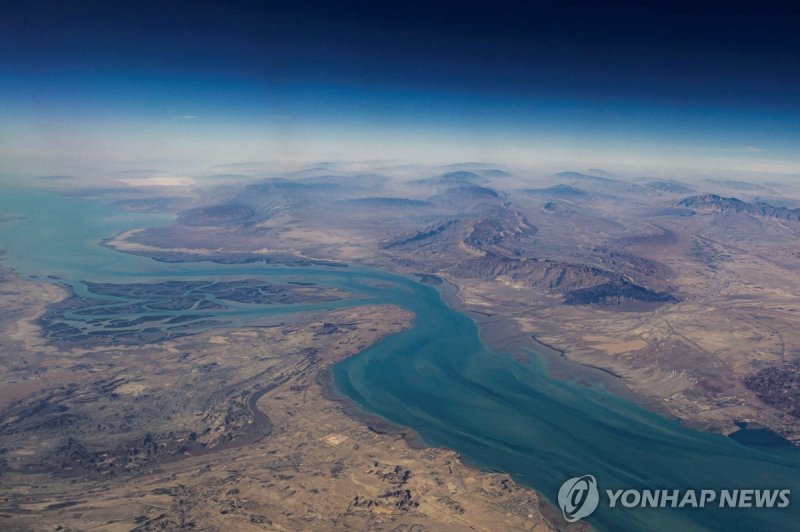
For this reason, some military experts are raising the possibility of a more hardline option: seizing control of the southern coastline of the Islamic Republic of Iran. Under this plan, U.S. forces would secure the coast to prevent Iranian forces from mounting attacks on the strait.
Such a scenario would likely require a long-term campaign involving the deployment of several thousand U.S. military ground troops. The operation is expected to begin with large-scale airstrikes to weaken Iran’s coastal defenses, followed by an amphibious landing by the United States Marine Corps (USMC).
In particular, observers say an amphibious landing by the USMC along the mountainous southern coast of the Islamic Republic of Iran is being discussed as a possibility. After that, the United States would seek to establish a certain-sized buffer zone inside Iranian territory to guarantee safe passage through the strait.
Even if the coastline of the strait is brought under control, the threat would not disappear completely. The Islamic Republic of Iran possesses long-range missiles and drone forces that can be launched from inland.
The Islamic Revolutionary Guard Corps of Iran (IRGC) has a force of about 190,000 personnel and operates the Quds Force, an elite unit specializing in asymmetric warfare. The organization supports rebel groups across the Middle East and has experience backing attacks against U.S. forces since the Iraq War in 2003.
Experts point out that as long as these threats remain, shipping companies will find it difficult to use the Strait of Hormuz route under normal conditions. They conclude that restoring the normal traffic volume of more than 100 ships a day will ultimately require an end to hostilities with the Islamic Republic of Iran and a firm guarantee from the Iranian government that it will cease attacks on vessels.
[email protected] Kim Kyung-min Reporter