Just $10 to Oust Iran’s Leader: Outrage Over Betting on War
- Input
- 2026-03-16 10:44:54
- Updated
- 2026-03-16 10:44:54
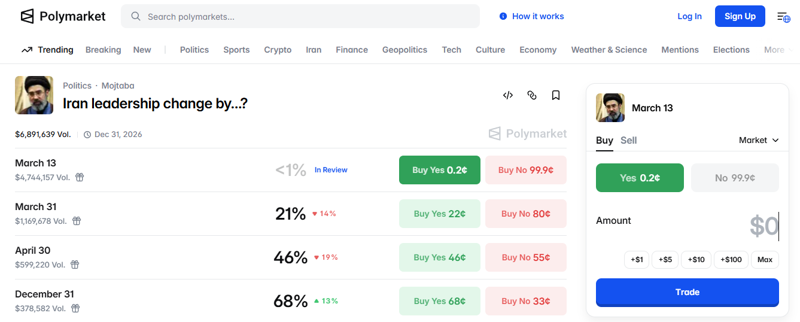
According to The Financial News, prediction market platforms that drew attention last year for forecasting the winner of the U.S. presidential election are now expanding into bets on war in the Islamic Republic of Iran, prompting accusations of unethical behavior.
On the 15th (local time), the British Broadcasting Corporation (BBC) reported that prediction market platforms such as Polymarket and Kalshi are exploding in popularity in the United States. They have moved beyond sports gambling to allow bets on politics, war, and even the deaths of specific individuals, fueling intense ethical and legal controversy.
The BBC highlighted a case in which, just weeks before U.S. and Israeli airstrikes on the Islamic Republic of Iran, news spread on social media that pizza orders at the U.S. Department of Defense headquarters, The Pentagon, in Washington, D.C., had suddenly surged. A man in his mid-30s living in the State of Montana then wagered $10 on Supreme Leader Ali Hosseini Khamenei being removed from power before March 1.
Markets built around major prediction platforms have grown rapidly, recording more than $44 billion in transactions over the past year. The legalization of sports betting in 2018 and a 2024 ruling allowing election-related bets acted as catalysts.
For now, most bets still focus on the outcomes of sporting events. However, users can also stake money on various elections, the likelihood of interest rate cuts by the Federal Reserve System (the U.S. central bank), and even the year in which the second coming of Jesus Christ is expected.
In particular, these platforms earned a reputation for providing "reliable data" after accurately predicting the victory of then President-elect Donald John Trump in the 2024 U.S. presidential election. More recently, though, they have come under fire for what critics call "gruesome bets" tied to military actions in conflict zones such as the Islamic Republic of Iran, the Bolivarian Republic of Venezuela, and Israel.
On Polymarket alone, some $500 million has flowed into bets related to war in the Islamic Republic of Iran. At one point, the site even listed a contract allowing users to bet on whether a nuclear explosion would occur, before removing it in the face of public backlash.
Critics describe this phenomenon as a form of "war profiteering" and even "a threat to national security."
Craig Holman of the civic group Public Citizen said, "We are witnessing a deeply chilling situation in which people are gambling on the deaths of heads of state," urging authorities to launch a strong crackdown.
Allegations of insider trading have emerged as a key flashpoint. Just before the official announcement in January that Bolivarian Republic of Venezuela President Nicolás Maduro had been detained, one user reportedly made hundreds of thousands of dollars in profit, heightening fears that military and diplomatic secrets are being turned into a source of gambling revenue.
The platforms, for their part, insist that this is not gambling but a form of "financial product."
They argue that by converting the probability of specific events into prices, they help companies hedge against future uncertainty.
Buoyed by the deregulatory stance of the Trump administration, an argument has been gaining ground within the Commodity Futures Trading Commission (CFTC) that "this market performs a legitimate economic function."
As the controversy intensified, Kalshi canceled its bets related to Khamenei and refunded $54 million in wagers. The company explained, "We have a rule that we do not open markets that are settled by a person’s death." Users, however, reacted with cynicism, saying the platform "knew perfectly well what 'removal from power' really implied, kept the market open anyway, and is only now trying to back out."
In the United States, fierce legal battles are now underway between state and federal authorities over whether to treat these apps as "financial exchanges" or as "gambling operations."
The BBC reported that the Democratic Party has introduced a bill to ban public officials from trading in event contracts, stepping up the pressure. However, with a new administration favoring deregulation set to take office, the path to actual regulation is expected to be difficult.
[email protected] Yoon Jae-joon Reporter