"Let's Create Trade Boards": Senior U.S.-China Meeting in Paris Ahead of Summit
- Input
- 2026-03-16 08:46:11
- Updated
- 2026-03-16 08:46:11
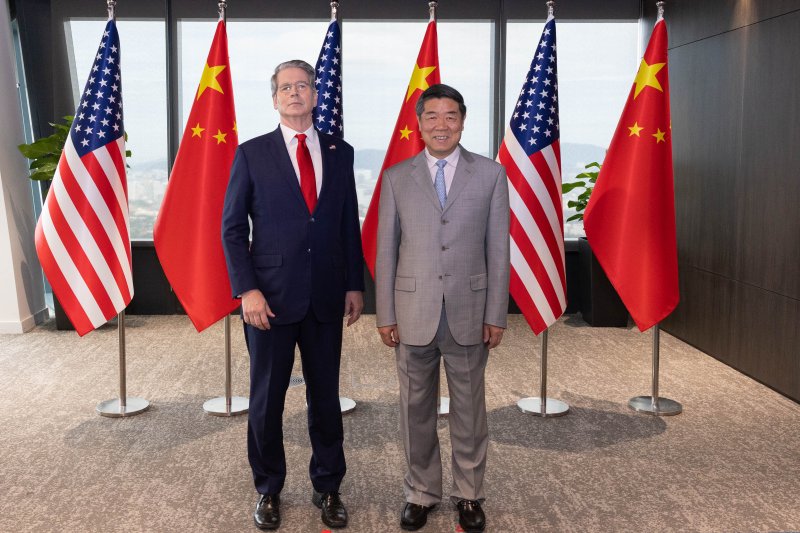
[Financial News] The United States of America (U.S.) and China have begun high-level consultations ahead of their summit scheduled for later this month. The two sides are working to align summit agendas, including expanding agricultural trade, securing supplies of critical minerals, and establishing new mechanisms to manage trade. Observers say energy supply issues triggered by the war in the Middle East may also be on the table.
According to major foreign media on the 15th (local time), delegations from the U.S. and China met that day at the headquarters of the Organisation for Economic Co-operation and Development (OECD) in Paris and held more than six hours of talks. United States Secretary of the Treasury Scott Bessent and Vice Premier of China He Lifeng led their respective delegations.
The meeting was arranged to coordinate in advance the agenda for the summit between U.S. President Donald Trump and President of the People's Republic of China Xi Jinping, which is expected to take place in Beijing later this month. The two sides are expected to continue their discussions on the 16th.
The U.S. Department of the Treasury did not disclose the tone of the talks or specific details of the discussions. The Chinese side also left the venue without making separate comments. However, sources familiar with the negotiations said the talks were conducted "in a calm, candid and constructive atmosphere, and the two sides examined potential areas of agreement for the summit, including agriculture, critical minerals and trade management frameworks."
China is reported to have maintained its earlier pledge to purchase 25 million tons of U.S. soybeans annually for the next three years, while also signaling openness to increasing imports of other U.S. agricultural products such as poultry, beef and various grains.
The two countries also discussed creating new bodies to manage trade and investment. One proposal is to establish a "Board of Trade" and a "Board of Investment" to provide institutional oversight of bilateral trade and investment issues.
The trade board would be tasked with identifying products and industries where trade can be expanded without undermining either country's national security or critical supply chains. The investment board is being considered as a possible channel for resolving individual investment disputes and regulatory issues.
Critical minerals were another key topic. The U.S. side reportedly raised concerns about the stability of supplies of Chinese critical minerals. Washington conveyed its worries over potential shortages of yttrium, a rare-earth metal used in jet engine turbines for the aerospace industry. The U.S. is also said to hope that China will increase its purchases of Boeing aircraft as well as U.S. coal, petroleum and natural gas.
This round of talks also marked the first face-to-face meeting between the two countries since the Supreme Court of the United States (SCOTUS) ruled on the 20th of last month that Trump did not have the authority to impose tariffs based on the International Emergency Economic Powers Act (IEEPA).
Since that ruling, the Trump administration has been restructuring its tariff policy by invoking other legal grounds, including introducing a 10% global tariff and launching an investigation under Section 301 of the Trade Act of 1974.
Developments in the Middle East are also seen as a variable in the negotiations. Tensions in global energy markets have risen after attacks by the U.S. and Israel on the Islamic Republic of Iran prompted Tehran to effectively blockade the Strait of Hormuz.
The Strait of Hormuz is a vital chokepoint through which about 20% of the world's crude oil shipments pass. China brings in roughly 45% of its crude oil imports through this waterway.
Trump argued on Truth Social the previous day that major countries such as the Republic of Korea (ROK), China, Japan, United Kingdom (UK), France and others should dispatch warships to help secure the safety of the strait.
The U.S. and Chinese leaders had already agreed to ease some trade tensions at their meeting held last October at Gimhae Air Base in Busan. At that time, China agreed to suspend for one year its export controls on rare-earth elements, while the U.S. agreed to cut the so-called "fentanyl tariff" imposed on China from 20% to 10%.
China also agreed to resume purchases of U.S. soybeans, which it had previously halted, and the U.S. pledged not to further expand restrictions on trade in advanced technology products such as semiconductor manufacturing equipment.
The Paris talks are the first high-level negotiations to prepare for a U.S.-China summit since those agreements, and are expected to serve as a test of the future trajectory of bilateral relations.
[email protected] Kim Kyung-min Reporter