Escalating Tensions Between the United States and Iran... No Clear Way to Stop War
- Input
- 2026-03-15 18:13:30
- Updated
- 2026-03-15 18:13:30
Both the United States and Iran are reported to have rejected mediation efforts by Oman and other Middle Eastern countries. On the 14th (local time), U.S. President Donald Trump said, "Iran wants to negotiate, but I do not want to yet because the terms are not good enough." Iran, for its part, has declared that it will reject any possibility of a cease-fire until U.S. and Israeli airstrikes stop, pushing the war further toward a long-term confrontation.
■ United States and Iran focus attacks on oil facilities
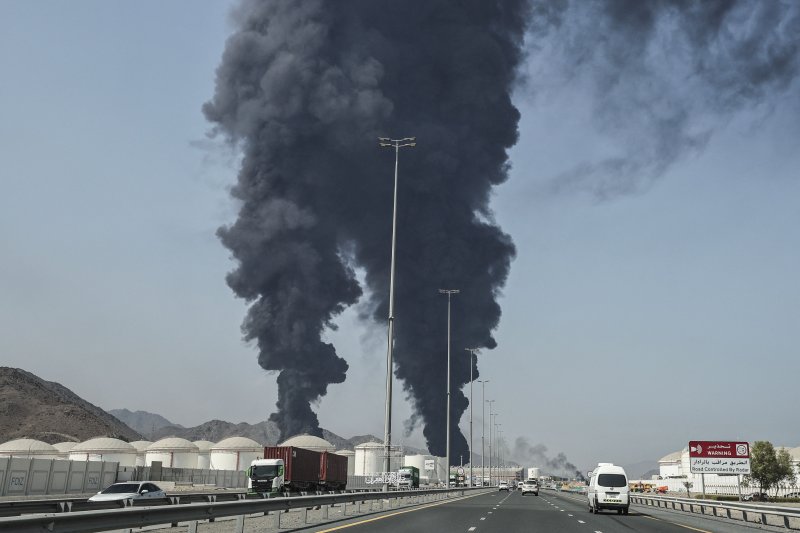
Iran, which has been blocking the Strait of Hormuz — the waterway linking the Persian Gulf and the Indian Ocean — for about two weeks, attacked the Port of Fujairah in the United Arab Emirates (UAE) on the 14th. One or two Iranian Shahed drones crashed into oil storage tanks at the port, sparking a fire. Located on the Indian Ocean, the Port of Fujairah is connected to the UAE’s oil fields by an onshore pipeline about 400 kilometers long. By using these facilities, the UAE can export oil to Asia and elsewhere without passing through the Strait of Hormuz.
Khatam al-Anbiya Central Headquarters, Iran’s joint military command, claimed in a statement the same day that the missiles and other weapons used to strike Kharg Island the previous day were launched from U.S. bases inside the UAE. It added, "Iran has the right to defend our sovereignty and territory by striking U.S. missile launch bases hidden in major ports, docks, and cities across the UAE." The command also warned that it would target key UAE ports, including Khalifa Port in Abu Dhabi and Jebel Ali Port in Dubai. Foreign media reported that shipping at the Port of Fujairah was briefly halted by Iran’s attack but resumed on the 15th.
The United States moved to hit Iran’s economic base after Tehran tightened control over the Strait of Hormuz, through which about 20% of the world’s seaborne oil trade passes, sending international oil prices soaring. United States Central Command (CENTCOM) announced on social media on the 14th that it had carried out precision strikes on Kharg Island in the northern Persian Gulf the previous day and had "hit more than 90 military targets." The island hosts terminals that handle about 90% of Iran’s oil exports and is a core pillar of the Iranian economy. In an interview with NBC on the same day, Donald Trump insisted that although the United States had completely destroyed Kharg Island, it "did not attack any oil facilities." He added that the United States could "hit Kharg Island a few more times for fun."
Iranian Foreign Minister Abbas Araghchi appeared on state television the same day and warned, "If attacks on energy facilities continue, Iran will strike facilities of U.S. companies or companies in which the United States holds shares in the Middle East."
■ Middle East under fire... death toll exceeds 3,000
Cable News Network (CNN) reported on the 15th that the war with Iran has claimed at least 3,000 lives. The Human Rights Activists News Agency (HRANA), a U.S.-based Iranian human rights group, estimated on the 13th that cumulative deaths inside Iran had reached 2,420, including 1,298 civilians — among them 205 children — and 1,122 soldiers. The Ministry of Public Health of Lebanon also announced on the 14th that clashes between the pro-Iran group Hezbollah and Israel since the start of the war had left 826 people dead in Lebanon alone.
Casualties have also been reported in the United States and Israel. As of the 14th, the cumulative U.S. death toll stood at 13, while 15 people had been killed in Israel. The United Arab Emirates (UAE) and the State of Kuwait each reported six deaths, and two people were killed in the Kingdom of Saudi Arabia on the 8th. According to United Kingdom Maritime Trade Operations (UKMTO), at least 17 vessels near the Strait of Hormuz have come under suspected long-range Iranian attacks over the past two weeks. Iran’s military stated that shortly after Ayatollah Seyyed Mojtaba Khamenei, Iran’s newly appointed supreme leader, declared a hard-line response in his first official address on the 12th, it "fired 30 missiles with warheads weighing 1 to 2 tons" toward Israel. Israel, in a statement on the 13th, said that 90 fighter jets had dropped 200 bombs on Iranian government facilities in a single day. The United States has offered a reward of up to 10 million dollars (about 14.981 billion won) for information on Mojtaba and others.
The Wall Street Journal (WSJ) reported on the 13th that a U.S. military base in the Kingdom of Saudi Arabia had been hit by Iranian missile strikes, damaging five U.S. aerial refueling aircraft. Donald Trump immediately dismissed the report the next day as false. As the fighting intensified, the United States on the 14th ordered all U.S. citizens in the Republic of Iraq to leave immediately. With the Iran crisis dragging on, international oil prices have stayed above 100 dollars per barrel for two consecutive days. May-delivery futures for Brent crude oil closed at 103.13 dollars per barrel on the 13th, the highest level in 3 years and 7 months since July 2022.
Facing midterm elections in November, Donald Trump was asked whether high oil prices could affect the vote. He replied, "I am not worried at all," and asserted, "The only thing I want is to make sure Iran can never again become the tyrant of the Middle East."
[email protected] Park Jong-won Reporter