Ultra-fast supplementary budget in response to high oil prices, up to 20 trillion won... Targeted support and consumption coupons taking shape
- Input
- 2026-03-15 18:12:33
- Updated
- 2026-03-15 18:12:33
According to the government on the 15th, the budget and tax authorities have been working at full speed since last weekend, without a break, to complete the government’s supplementary budget proposal within this month. Even on this holiday afternoon, Kim Yong-beom, Chief Presidential Secretary for Policy at Cheong Wa Dae (the Blue House), reportedly convened a vice-ministerial meeting of relevant ministries on the supplementary budget.
An official at the Ministry of Planning and Budget stated, "The Ministry of Finance and Economy has begun work on revising revenue estimates in parallel with drafting the supplementary budget," adding, "We will streamline procedures from the stage of receiving project requests from each ministry that align with the purpose of the supplementary budget, so the process can be fast and efficient." This supplementary budget is characterized by its emphasis on speed, given the urgency of the war situation. Waiting until the end of this month to fully reflect corporate tax filing and payment data would improve the accuracy of revenue revisions, but it would also slow the process. As a result, a more proactive, top-down approach that shortens several procedures is expected. In terms of content, because this is a supplementary budget in response to high oil prices, a substantial portion is likely to be allocated to expanding fiscal resources to compensate losses at oil refining companies following the implementation on the 12th of the Petroleum Product Price Ceiling System.
Support for transportation and logistics sectors such as freight and taxi services, as well as companies exporting to or operating in the Middle East, is expected to fall under the category of “high oil price damage relief.” This category is also likely to include the Energy Voucher Program for low-income and vulnerable households and fuel subsidies for farmers and fishers. Measures to support the livelihoods of low-income households and small business owners, stabilize youth employment and consumer prices, and revitalize regional economies through construction projects may be grouped under “livelihood and price stabilization.” Investment projects in infrastructure related to the energy transition, including Social Overhead Capital (SOC), could also be included.
Unlike the previous supplementary budget, however, this one is expected to move away from universal support and instead apply more finely tuned, differentiated assistance based on the degree of damage and income level, while narrowing the scope of beneficiaries. Reflecting a proposal by President of South Korea Lee Jae-myung, who argued that "local currency is better than cash, because it has a double effect," the package may include direct support in the form of local currency to help those hit by high oil prices, small business owners, and neighborhood commercial districts, while also providing an emergency boost to domestic demand. In effect, a second round of the Livelihood Recovery Consumption Coupon Program, limited to affected groups, could be introduced.
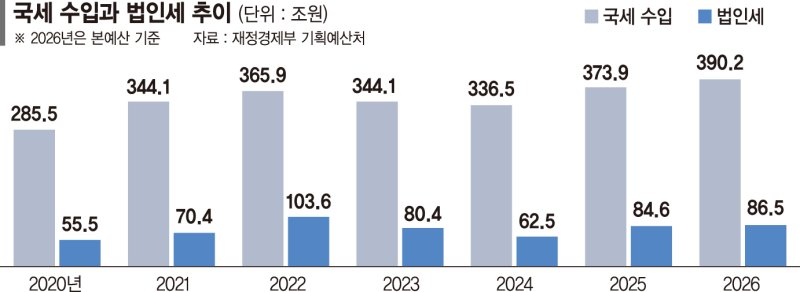
Political and policy circles are discussing a supplementary budget in the range of 15 to 20 trillion won. Considering that the National Assembly of the Republic of Korea typically increases the government’s proposal by about 5 percent during deliberations, the final amount could reach the low to mid-20 trillion won range. The government plans to fund this supplementary budget through excess tax revenue, surplus funds from the previous fiscal year, and restructuring of unused expenditures. This year’s national tax revenue is projected at 390.2 trillion won, of which corporate tax is the third-largest component at 86.5 trillion won. Market observers expect additional corporate tax revenue to exceed 5 trillion won, thanks to record operating profits last year at Samsung Electronics Co., Ltd. and SK hynix Inc., which together are forecast to have earned about 90 trillion won. In the previous year, corporate tax revenue came in 22 trillion won above expectations. Monthly receipts from the Securities Transaction Tax will also be tapped for the supplementary budget; in January alone, 400 billion won was collected, up 52 percent from a year earlier.
If more than 10 trillion won in additional funds is injected through the supplementary budget on top of this year’s record-high total government expenditure of 727.9 trillion won, the increased money supply could amplify the burden on ordinary households by fueling inflation and pushing up exchange rates, real estate prices, and government bond yields in the wake of the high oil price shock. There is also a risk that the deficit in the Managed Fiscal Balance—projected at 107.8 trillion won this year, or minus 3.9 percent of GDP—and Government Debt, expected to reach 1,413.8 trillion won, or 51.6 percent of GDP, will grow further.
Kyucheol Jung, a Senior Research Fellow at the Korea Development Institute (KDI), noted, "Last year, it was enough just to boost depressed demand, but in a supply shock like this one, it is very difficult to design policies that rely on injecting money," and added, "It is more effective to focus on vulnerable groups and industries that are closely tied to high oil prices and to execute support quickly on a relatively small scale."
[email protected] Jeong Sang-geun, Choi Yong-jun and Seo Young-jun Reporter