Stomach-Churning Korean Stock Market, Large-Cap Concentration to Blame
- Input
- 2026-03-15 18:07:35
- Updated
- 2026-03-15 18:07:35
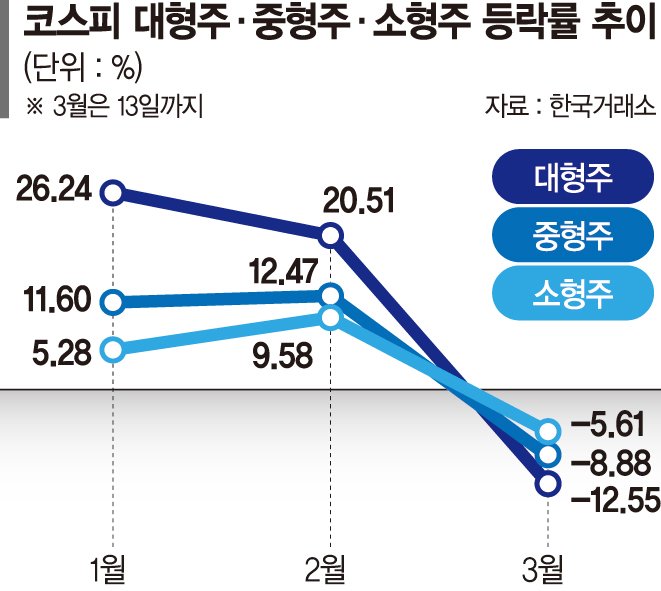
According to the Korea Exchange (KRX) on the 15th, the Korea Composite Stock Price Index (KOSPI) has fallen 12.12% so far this month. This comes after a 75.63% surge last year and a further 48.17% jump through February this year, but the market has turned lower since war broke out between the United States and Israel on one side and Iran on the other.
Large caps have been especially volatile. This month, KOSPI large-cap stocks have dropped 12.55%, a steeper decline than KOSPI mid caps at minus 8.88% and small caps at minus 5.61%.
Mid- and small-cap stocks, which had lagged in the earlier uptrend, are holding up relatively better in the current volatile market. Last year, large caps climbed 82.23%, while mid caps rose 40.06% and small caps only 20.21%. Even through last month this year, large caps had jumped 52.13%, compared with gains of 25.51% for mid caps and 15.36% for small caps.
Because large caps were the main drivers of the recent bull run, they are now seeing heavier selling in this correction phase. Their sharp ascent attracted abundant liquidity, which in turn is amplifying the magnitude of their price swings.
Large caps have bulked up rapidly during the rally. As of the 13th, the top 10 stocks by market capitalization on the KOSPI accounted for 51.72% of the index, up sharply from 41.09% at the end of March last year. Over the same period, the combined weight of the two leading semiconductor names, Samsung Electronics and SK hynix, expanded from 23.65% to 38.29%.
Given the geopolitical risks, this period of heightened volatility is expected to persist for some time. Dongchan Yeom, a researcher at Korea Investment & Securities, noted, "It is difficult to say that the KOSPI is in a stable phase," adding, "From the perspective of maximum drawdown (MDD), a potential bottom for the KOSPI could be around the 4,885 level."
However, many analysts still expect the market to eventually resume an upward trend when fundamentals are taken into account. Lee Jae-man, a researcher at Hana Securities, said, "If next month’s earnings announcements by tech companies, led by semiconductor firms, meet expectations, there is a high likelihood that the index will return to an upward trajectory, supported by the continuation of the global economic expansion cycle."
Attention is now focused on Nvidia GTC 2026 (Nvidia GPU Technology Conference 2026), which will be held from the 16th to the 19th (local time). At the event, Nvidia is expected to unveil its roadmap for next-generation graphics processing units (GPU) and its strategy for Artificial Intelligence (AI) infrastructure. Lee Sang-jun, researcher at NH Investment & Securities, predicted, "Although the market is exposed to high volatility stemming from geopolitical risks, the events scheduled for this week are likely to reaffirm the momentum for a rebound in the domestic market."
[email protected] Seo Min-ji Reporter