After Instant Noodles, Snacks and Ice Cream Face Price Cuts as Government Pressure Threatens Investment
- Input
- 2026-03-15 17:58:08
- Updated
- 2026-03-15 17:58:08
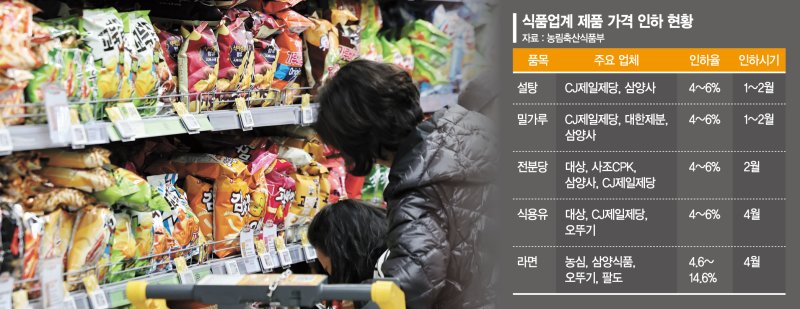
According to industry sources on the 15th, the government held a closed-door meeting with the cooking oil and instant noodle industries near Seoul Station from the 4th to the 5th. It now plans to hold similar meetings with the mass-produced bread, snack, and ice cream industries.
Officially, the meetings are intended to gauge market trends and listen to industry concerns. However, they are also understood to be a venue for asking companies to support the government’s price-stabilization policy following price cuts and a collusion case in the flour industry. This move is in line with the Public Livelihood Price Special Management Ministerial Task Force (TF) meeting held on the 12th, chaired by Deputy Prime Minister for Economic Affairs and Minister of Finance and Economy Koo Yoon-cheol. At that meeting, the government designated 23 items, including rice, processed foods, cooking oil, and telecommunications fees, as special management items.
Through the Special Task Force on Livelihood Prices, the government plans on-site inspections and institutional reforms to increase transparency in how prices are set.
Earlier, after sugar and flour producers that had been investigated by the Korea Fair Trade Commission (KFTC) for collusion cut sugar and flour prices by about 5%, President Lee Jae Myung remarked, "We cannot allow companies to monopolize the results of the KFTC’s hard work." Following that comment, a bakery company lowered prices for bread and cakes. Starting next month, six cooking oil producers, including CJ CheilJedang and Daesang, will cut prices by an average of 3–6%, while four instant noodle makers, including Nongshim, Samyang Foods, and Ottogi, will reduce prices by about 4.6–14.6% on average.
The food industry’s concerns are deepening rather than easing. Companies in the confectionery and ice cream sectors, which the government has now singled out, are particularly anxious. Haitai Confectionery & Foods’ preemptive move to cut prices on two biscuit products by up to 5.6% is seen in this context. It is the first time since flour and sugar suppliers lowered raw material prices that a confectionery company has reduced its product prices.
Food companies say they understand the government’s focus on stabilizing prices, but argue that structural constraints make price cuts difficult as fixed costs such as raw materials, labor, and logistics continue to pile up. Because they rely heavily on imports for key ingredients like wheat and corn, many analysts say that any increase in volatility in the won–dollar exchange rate will inevitably push their costs higher.
An industry official stated, "Food companies that have already lowered prices are in a situation where they must accept a certain level of reduced profitability." The official added, "Companies that have not cut prices are also struggling, as their cost burden is growing." Another industry representative lamented, "We are actually in a position where we should be raising product prices, but instead we are being pushed to lower them. I worry this will make it harder to expand new investments, including future global business expansion."
A government official responded, "We will identify cost factors affecting companies, such as raw material and logistics expenses stemming from uncertainties in the Middle East, and at the same time pursue policies to ease cost burdens and support industries, including through exports."
ssuccu@fnnews.com Kim Seo-yeon Reporter