Will President Lee Jae Myung Dispatch the Cheonghae Unit to the Strait of Hormuz? Donald John Trump Asks Five Countries, Including South Korea, to Send Warships
- Input
- 2026-03-15 10:01:58
- Updated
- 2026-03-15 10:01:58
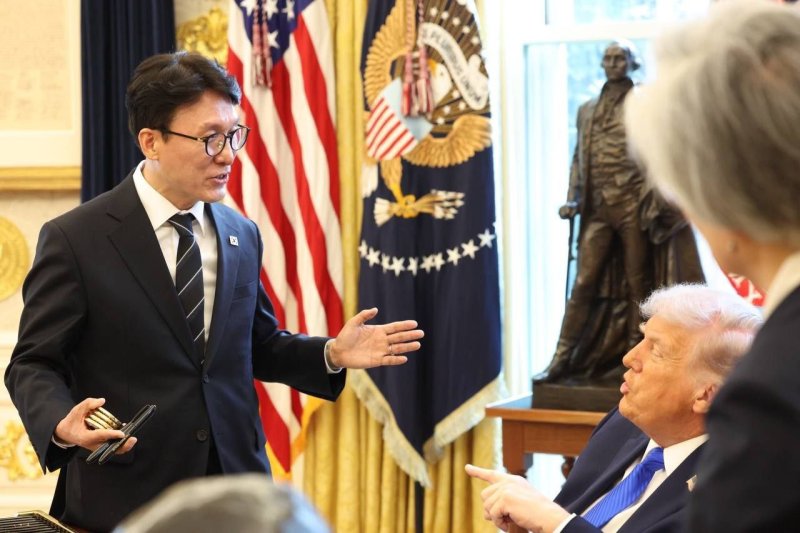
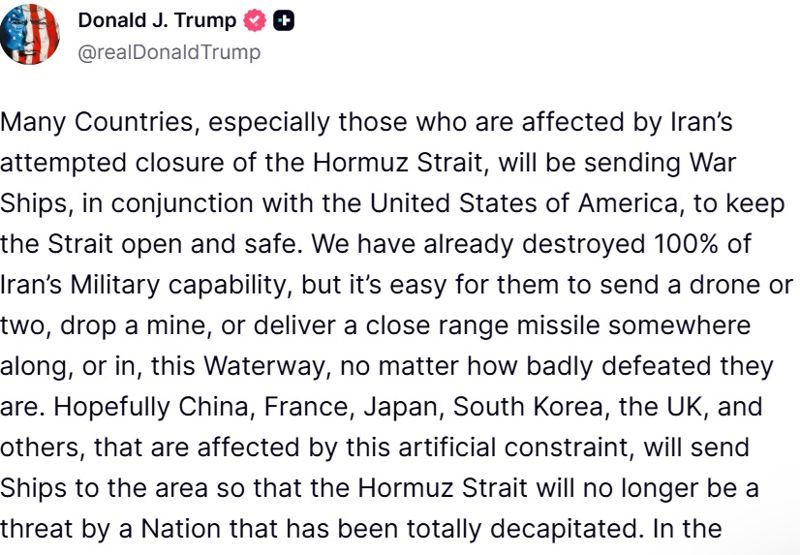
According to diplomatic sources on the 15th, whether President Lee Jae Myung will deploy the Cheonghae Unit, currently operating in the nearby Gulf of Aden, to protect South Korean vessels trapped in the Strait of Hormuz has become a matter of keen interest. After his meeting with Prime Minister Kim Min-seok at the White House, Donald Trump used his social media platform to ask five countries, including South Korea, to send naval vessels to the Strait of Hormuz. On the 14th (local time), he urged countries suffering losses from the blockade of the Strait of Hormuz to send warships and join efforts to maintain the security of the waterway. In a post on Truth Social that day, he said, "Countries affected by the Islamic Republic of Iran's attempt to blockade the Strait of Hormuz will send warships, together with the United States, to keep the strait open and safe." He added, "China, France, Japan, South Korea, the United Kingdom, and other countries affected by this artificial constraint will send vessels here so that the Strait of Hormuz is no longer threatened by a country whose leadership has been completely removed."
It has been reported that around 20 South Korean ships have recently been isolated due to the Islamic Republic of Iran's blockade of the Strait of Hormuz, but there has been no direct involvement by South Korean forces so far. However, as some reports indicate that Japan is considering deploying the Japan Self-Defense Forces (JSDF) to the Strait of Hormuz, the dilemma facing the Lee Jae Myung administration is expected to deepen. Japanese Prime Minister Sanae Takaichi will travel to the United States from the 18th for a four-day visit to hold talks with Donald Trump. There is speculation that, during the U.S.-Japan summit, Donald Trump may formally request the dispatch of the JSDF.
At present, South Korean forces are not permanently stationed around the Strait of Hormuz. The Cheonghae Unit, however, is operating in nearby waters in the Gulf of Aden off the Federal Republic of Somalia with one navy destroyer and about 300 personnel.
The Cheonghae Unit has mainly focused on anti-piracy operations in the Gulf of Aden and the protection of commercial vessels, but its operational area was temporarily expanded to include the Strait of Hormuz from 2020 to 2021. In January 2021, when the Islamic Revolutionary Guard Corps (IRGC) seized a South Korean tanker, the destroyer ROKS Choi Young was urgently dispatched to the Strait of Hormuz. It is known that the unit can be sent there on short notice, with a sailing time of three to four days. Meanwhile, Michael George DeSombre, Assistant Secretary of State for East Asian and Pacific Affairs at the United States Department of State (State Department), stayed in South Korea and Japan from the 9th to the 15th to discuss cooperation related to the Iran situation. The Ministry of Foreign Affairs has consistently denied that Assistant Secretary of State for East Asian and Pacific Affairs DeSombre requested the deployment of South Korean troops.
rainman@fnnews.com Kim Kyung-soo Reporter