What Will Happen to Highly Leveraged Borrowers as Bank Mortgage Rates Top 6.5%
- Input
- 2026-03-15 08:47:39
- Updated
- 2026-03-15 08:47:39
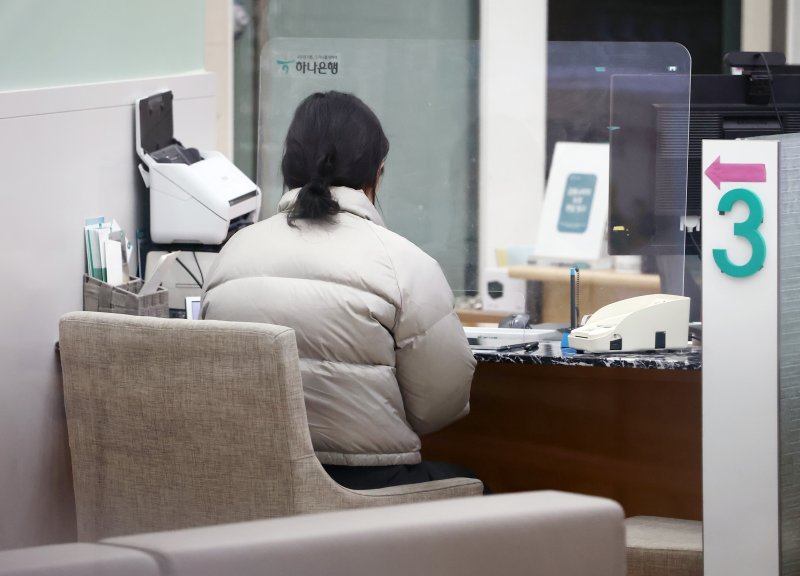
[Financial News] The upper end of banks’ mortgage loan rates has climbed above 6.5%. Expectations that the global rate‐cut cycle is ending, combined with the recent crisis in the Middle East, have pushed household lending rates up by 0.2 percentage points in just two months. This could significantly increase the burden on highly leveraged homebuyers who "scraped together everything to buy a house" and on investors engaging in debt‐fueled investing.
According to the financial sector on the 15th, as of March 13 the mixed (fixed‐rate) mortgage loans at KB Kookmin, Shinhan, KEB Hana and Woori Bank, based on five‐year bank bonds, were in the range of 4.250% to 6.504% per year.
Compared with January 16, when the range was 4.130% to 6.297%, the upper end has risen by 0.207 percentage points and the lower end by 0.120 percentage points in about two months. Over the same period, the yield on five‐year bank bonds, a key benchmark for fixed rates, jumped from 3.580% to 3.860%, an increase of 0.280 percentage points.
Looking at the internal time series of Bank A, which applies the highest rates, the current level is the highest in about two years and five months, surpassing the level seen at the end of October 2023 (6.705%).
Unsecured personal loan rates stand at 3.930% to 5.340% per year for top‐tier borrowers on a one‐year term, with the lower end also 0.180 percentage points higher than two months ago. The yield on one‐year bank bonds, the relevant benchmark, has risen by 0.200 percentage points over the same period. In Bank B’s internal time series, this is the highest level in about one year and three months, since late December 2024 (5.680%).
Variable‐rate mortgage loans tied to the new COFIX, currently at 3.850% to 5.740% per year, have also seen both the upper and lower ends rise over the period, by 0.090 and 0.106 percentage points respectively.
The Cost of Funds Index (COFIX), a major benchmark rate, has actually fallen by 0.120 percentage points. This suggests that banks have widened their discretionary spreads added for loan volume management, or adjusted preferential rates.
The Bank of Korea (BOK) has kept its base rate at 2.50% for eight consecutive months since last July. However, banks judge that market rates effectively completed their easing cycle in the second half of last year and have already entered an upward phase.
As of the 12th, the total outstanding household loans at the five major banks—KB Kookmin, Shinhan, KEB Hana, Woori and NH Bank—stood at 766.5501 trillion won, up 684.7 billion won from the end of February.
Mortgage loans fell by 830.2 billion won due to various government real estate regulations, but unsecured personal loans surged by as much as 1.4327 trillion won. If this pace continues through the end of the month, it will mark the largest monthly increase in four years and eight months, since July 2021, when such loans grew by 1.8637 trillion won.
In particular, the outstanding balance actually drawn on personal overdraft accounts has increased by 1.3114 trillion won so far this month alone, from 39.4249 trillion won to 40.7362 trillion won. Despite regulators’ warnings against debt‐fueled investing, the increase is even larger than the 1.2979 trillion won rise recorded as of the 5th, a week earlier.
Compared with previous month‐end figures, the size of overdraft account balances is now the largest in about three years and two months, since the end of December 2022 (42.0546 trillion won). Although the current data cover only 12 days, the increase is also the biggest on a monthly basis in about five years and three months, since November 2020, when the balance rose by 2.1263 trillion won.
A commercial bank official said, "The recent increase in bank unsecured loans is mainly due to transfers to securities firms," adding, "On days when the Korea Composite Stock Price Index (KOSPI) and KOSDAQ (Korean Securities Dealers Automated Quotations) plunged, transfers to securities firms exceeded 150 billion won in a single day."
The official went on to explain, "This reflects not only bargain‐hunting demand, but also cases where investors bought stocks using margin lending from securities firms, then faced margin calls and covered them with funds from overdraft accounts," and added, "Demand for subscription investments related to newly listed shares in recent Initial Public Offerings (IPO) has also contributed."
[email protected] Kang Gu-gwi Reporter