Prime Minister Kim Min-seok: "Trump asked me, 'Does Kim Jong Un want dialogue with the United States?'"
- Input
- 2026-03-14 08:39:03
- Updated
- 2026-03-14 08:39:03
During his visit to the United States, the prime minister attended a meeting with Korean correspondents held at the Korean Cultural Center Washington, D.C. that day. He stated, "A significant part of my conversation with President Trump was him asking for my views on the DPRK issue."
Prime Minister Kim explained that earlier in the day at the White House, he had been meeting with Pastor Paula Michelle White-Cain, director of the White House Office of Faith-Based and Neighborhood Partnerships. Through her arrangement, an unscheduled meeting with President Trump was set up, and he then had a conversation with the president in the Oval Office without an interpreter.
The prime minister recalled, "I told President Trump, 'President Lee Jae-myung often speaks about you. He frequently says you are the only leader who can resolve issues on the Korean Peninsula.'" He continued, "In response, President Trump showed interest in the DPRK, immediately asked his aide to bring a photo taken with Kim Jong Un, President of the State Affairs Commission of North Korea, at Panmunjom, and we talked while looking at that photo."
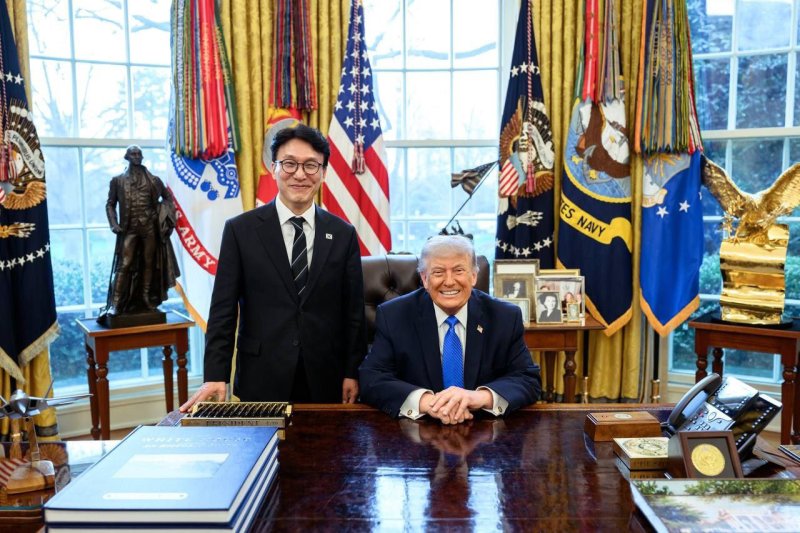
He went on, "President Trump said, 'I have maintained a good relationship with Chairman Kim, and I am wondering whether he wants dialogue with the United States or with me,' and he asked for my opinion." Kim added, "I shared several thoughts in response to that question."
The prime minister said, "I essentially told him that he is the only Western leader who has engaged in dialogue with the DPRK and Chairman Kim, and that I believe he is the only leader with the capacity to act as a peacemaker in resolving issues on the Korean Peninsula." He added, "President Trump took my remarks as very meaningful and reacted with clear satisfaction."
Prime Minister Kim did not disclose what specific proposals he made to President Trump.
He did note, however, "I said it would be desirable to increase contacts and dialogue, even to keep alive a small possibility of a summit between the leaders of the United States and the DPRK." He continued, "I pointed out that the DPRK’s rhetoric has slightly evolved—from previously saying there was 'no reason we cannot meet' to now using expressions such as 'there is no particular reason our relations have to be bad,' which seem to hint at normalizing relations. I told him that at the very least, the possibility for contact and dialogue remains open."
He added, "Among my suggestions, I do have a specific idea about what could serve as a card to break through the current deadlock." At the same time, he said, "It is difficult to make that public, but President Trump showed great interest in it."
Prime Minister Kim also said, "President Trump instructed his aide to look further into several points I raised and to consider what measures regarding the DPRK would be appropriate." He continued, "However, it is difficult for me to mention the concrete details of those instructions until the head of state himself makes them public."
The prime minister went on, "I asked President Trump whether it would be acceptable for me to put my assessments and opinions, which I had conveyed orally, into a more detailed memorandum in English and deliver it before I leave the United States." He said, "He told me to do so, and I plan to send it soon."
Kim also introduced that the previous day at the White House he had a joint meeting with U.S. Vice President J. D. Vance and Jamieson Greer, head of the Office of the United States Trade Representative (USTR).
At that meeting, referring to Section 301 of the Trade Act of 1974, under which the USTR recently initiated preliminary tariff procedures against 16 economic entities including the Republic of Korea, China, and Japan, the prime minister said, "Representative Greer made it clear that this is a measure applied broadly to many countries and that the Republic of Korea is not being singled out as a particular target."
He added, "At present, our government’s position regarding the Section 301 investigation is, first, that the Republic of Korea must not be placed in a disadvantageous position compared with other countries." He continued, "Representative Greer, however, said that depending on the circumstances, the Republic of Korea could even find itself in a more favorable position than others, and he suggested that we work through this issue together and maintain close communication."
[email protected] Lee Jeong-hwa Reporter