PPP Nomination Chief Lee Jung-hyun Resigns Amid Infighting, While Democrats Split Over Public Prosecution Office Bill
- Input
- 2026-03-13 13:48:41
- Updated
- 2026-03-13 13:48:41
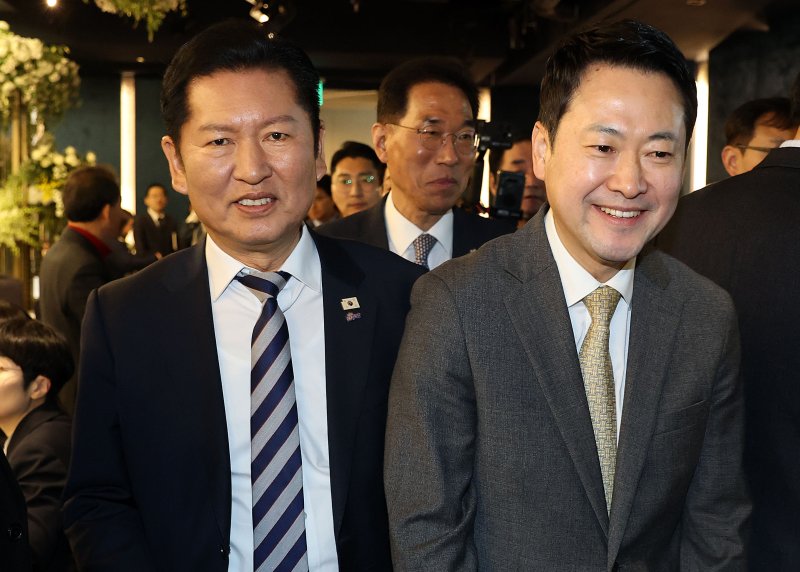
[The Financial News] The Democratic Party of Korea and the People Power Party (PPP) are both mired in internal strife, one over prosecutorial reform and the other over nominations for the June local elections. Within the Democratic Party of Korea, disagreements over the bill to establish a Public Prosecution Office have escalated to calls for a vote by all party members. In the PPP, reformist figures have resisted the nomination process, leading Nomination Management Committee Chairperson Lee Jung-hyun to step down voluntarily.
Debate over Public Prosecution Office’s supplementary investigation powers deepens factional conflict, prompting calls for a vote by all party members
According to political sources on the 13th, the Democratic Party of Korea has failed to narrow internal differences over whether to grant supplementary investigation powers to the Public Prosecution Office.
The core of the party’s prosecutorial reform plan is to dismantle the existing prosecution service and instead establish a Public Prosecution Office and a Serious Crime Investigation Agency, thereby separating indictment and investigation. The government bill for the Serious Crime Investigation Agency, coordinated between the administration and the party, has already gone to deliberation at the National Assembly’s Security and Public Administration Committee. In contrast, the Indictment Agency Act, which would create the Public Prosecution Office, continues to face resistance within the party, even though leaders had agreed to resolve the contentious issue of supplementary investigation powers later through amendments to the Criminal Procedure Act of the Republic of Korea.
Criticism has been led in particular by Choo Mi-ae, chair of the National Assembly’s Legislation and Judiciary Committee, and Representative Kim Yong-min of the Democratic Party of Korea, a member of the National Assembly’s Legislation and Judiciary Committee, who both sit on the committee that oversees the Indictment Agency Act. They argue that if the Public Prosecution Office is given supplementary investigation powers, the intended separation between indictment and investigation will effectively be nullified. Those on the other side counter that, since the government bill has already been adopted as the party line, it must be followed.
Tensions have further intensified due to allegations that the government attempted to negotiate with prosecutors to withdraw the indictment in the case involving President Lee Jae-myung of South Korea. The conflict over prosecutorial reform is increasingly taking the shape of a factional struggle between pro–Lee Jae-myung forces and those aligned with party leader Jung Chung-rae. Attention focused on the fact that Jung did not sign the request for an Investigation of State Administration into what the party calls fabricated indictments by prosecutors under the Yoon Suk Yeol administration, which was reportedly pursued with the aim of having the indictment withdrawn.
In response, some have proposed settling the issue through a vote by all party members. Kwon Chil-seung, a lawmaker running for Governor of Gyeonggi Province in the local elections, wrote on social media the same day, "The party is in turmoil over the prosecutorial reform bills. Personal political ambitions are flaring up, and we are even seeing signs of division within the ruling camp. It does not look like we will reach a conclusion," and then proposed, "Let’s hold a vote of all party members." He added that he personally supports accepting the government’s proposal.
PPP nomination chief quits over veto of Oh Se-hoon’s candidacy, but Jang Dong-hyeok holds his ground
Within the People Power Party (PPP), friction has grown as reformists, including Seoul Metropolitan Government Mayor Oh Se-hoon, have effectively vetoed party leader Jang Dong-hyeok.
In line with demands from the reformist camp, the party adopted a resolution to "cut ties with former President Yoon Suk Yeol," and Jang ordered the ethics committee to halt additional disciplinary measures. Even so, reformists continue to press for a sweeping reshuffle of personnel and the creation of an innovative election countermeasures committee. Their stance is widely interpreted as a call for Jang to step down.
As a way to force their demands through, the reformists have pointed to Mayor Oh’s refusal to apply for party nomination. During the initial nomination application period, Oh did not submit his application, urging changes in the party leadership. He again declined to participate when additional applications were accepted on the 12th, repeatedly calling for a personnel shake-up and the launch of an innovation-focused election committee.
Amid this turmoil over nominations, Nomination Management Committee Chairperson Lee Jung-hyun resigned from his post. In a statement, Lee said, "In the process of respecting various opinions, I concluded that it has become difficult to continue pursuing the direction I had in mind," adding, "I will take full responsibility and step down as chairperson of the Nomination Management Committee. I sincerely wish for the party’s unity and victory in the local elections."
Nevertheless, Jang has made it clear he will not simply raise the white flag. Speaking to reporters at the National Assembly about calls for a personnel overhaul and an innovation election committee, he indirectly rejected the demands, saying, "I believe fairness is the lifeblood of nominations." Regarding Lee’s resignation, he added, "I will meet with him as soon as I can reach him and hear what he has to say," indicating that he would try to persuade Lee to reconsider stepping down.
[email protected] Reporter Kim Yun-ho Reporter