National Judges Conference warns new complaint system may cause confusion, calls for stronger protection of criminal judges under new offense
- Input
- 2026-03-12 19:15:58
- Updated
- 2026-03-12 19:15:58
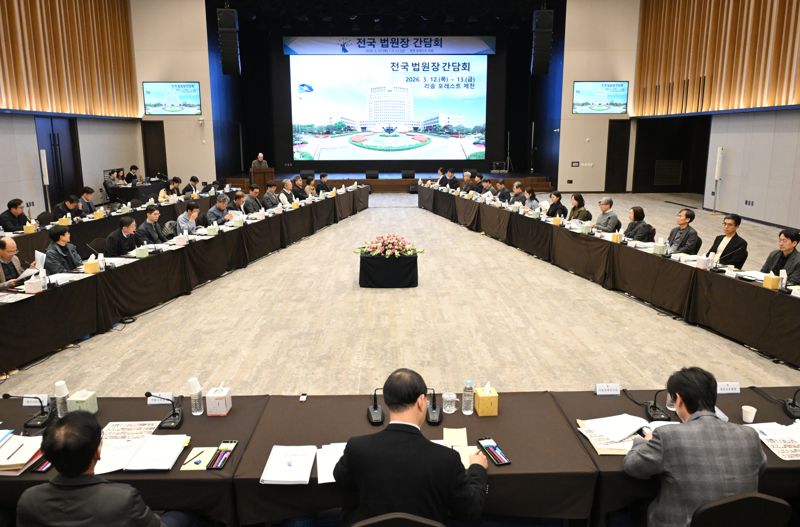
[Financial News] On the first day of the enforcement of the three judicial reform laws—the new "distortion of justice" offense, the constitutional complaint against court rulings, and the increase in the number of Supreme Court Justices—the National Judges Conference voiced concern that "the introduction of the constitutional complaint system could cause confusion in trial practice and institutional operations, and the introduction of the distortion of justice offense may intensify efforts to avoid criminal trial panels."
The National Court Administration of the Supreme Court of Korea held a meeting from 2 p.m. on the 12th, chaired by Judicial Research and Training Institute President Kim Si-cheol (19th class of the Judicial Research and Training Institute), with 44 presidents of courts nationwide in attendance, along with Vice President Ki Woo-jong (26th class) of the National Court Administration and its directors and division heads.
In his opening remarks, Vice President Ki Woo-jong of the National Court Administration said, "With the passage of the three judicial reform laws, the foundations of the judicial system are changing, and there are deep concerns about this. I ask that you pool your wisdom so that the judiciary can restore public trust and prepare practical alternatives."
Court presidents across the country expressed concern that, in connection with the introduction of the constitutional complaint against court rulings, the meaning of the relevant provisions of the Constitutional Court of Korea is unclear and related statutes have not been revised in parallel. They warned that this could lead to confusion in trial practice and institutional operations once the law takes effect. Specifically, they pointed to procedures for sending trial records at the constitutional complaint stage and the method by which the judiciary should submit its opinions. They also discussed as key issues the follow-up procedures for judgments that are annulled when a constitutional complaint is upheld, and the legal effect on judgments that have already become final.
Regarding the introduction of the distortion of justice offense, participants warned that avoidance of criminal trial panels could intensify in the future and that this may restrict the ability to conduct speedy and fair trials. They agreed that stronger protection is needed for judges handling criminal cases, including increased budget allocations, the establishment of a committee dedicated to protecting judges, the introduction of a criminal law specialist judge system, priority assignment of judicial researchers to criminal divisions, and higher allowances related to criminal trials.
On the increase in the number of Supreme Court Justices, participants said that measures are needed to prevent deterioration in fact-finding at the lower courts and to improve physical infrastructure such as court buildings. They discussed concrete measures such as increasing the number of judges to prevent weakened fact-finding, introducing a senior judge system, and expanding the number of judicial researchers.
The National Judges Conference will continue through tomorrow. On the final day, participants plan to discuss "the need to develop artificial intelligence (AI) and a phased roadmap to improve public access to judicial services."
[email protected] Lee Hwan-joo Reporter