Middle East war leaves U.S. stocks flat... Korean retail investors return home [United States–Iran war]
- Input
- 2026-03-12 18:56:33
- Updated
- 2026-03-12 18:56:33
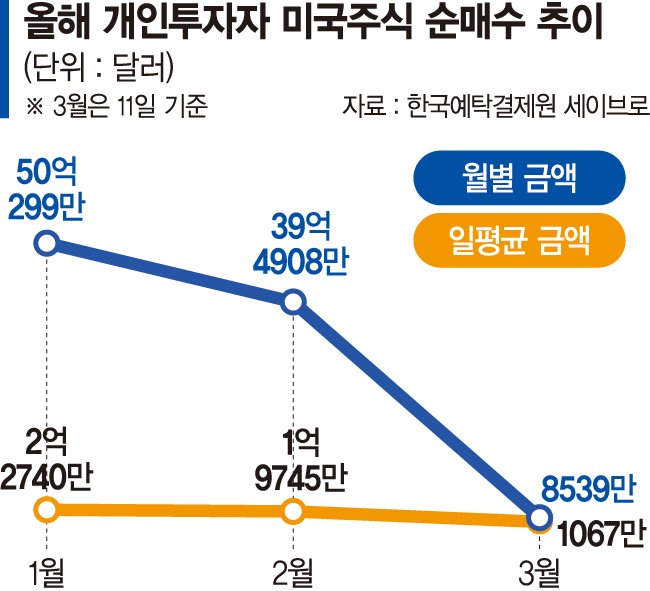
According to Korea Securities Depository (KSD) data from its Save-ro platform on the 12th, net purchases of U.S. stocks by domestic investors totaled 85.39 million dollars (about 124 billion won) between the 2nd and 11th of this month. Even allowing for the remaining days of the month, this is a steep drop compared with January and February, when net buying reached 5.00299 billion dollars (about 7.35 trillion won) and 3.94908 billion dollars (about 5.8 trillion won), respectively.
Average daily net purchases by month show a similar pattern. The figure plunged from 227.4 million dollars in January and 197.45 million dollars in February to 10.67 million dollars (about 15 billion won) as of the 11th of this month.
The total value of U.S. stocks held by Korean investors has also dropped sharply. On the 10th, their U.S. stock holdings stood at 164.18067 billion dollars, more than 10 billion dollars below the year’s peak of 174.383 billion dollars recorded on January 28. On the 5th, holdings fell to 157.80383 billion dollars, the lowest level so far this year.
By contrast, individual investors have significantly ramped up their buying in the South Korean stock market. From the 3rd to the 11th of this month, they recorded net purchases of 10.1084 trillion won on the domestic market. That is roughly three times the 3.4105 trillion won they bought on a net basis in February.
Analysts say that as the South Korean stock market has shown resilience despite the recent Middle East crisis, some Korean retail investors are treating the pullback in share prices as a buying opportunity and returning home. The Standard & Poor’s 500 Index (S&P 500), which broadly reflects conditions in the U.S. stock market, has been moving sideways, falling 1.53% so far this month, and this has also played a role. In contrast, the Korea Composite Stock Price Index (KOSPI) dropped 12.06% on the 4th but then gained 10.14% from the 5th through the previous trading day. Even on this day, despite a sharp jump in oil prices, more than 2 trillion won in net buying by individual investors helped limit the decline.
Lee Sang-heon, a researcher at iM Securities, stated, "While the KOSPI has been on an upward trend this year, the U.S. stock market has recently been slightly weaker overall," adding, "Some Korean retail investors appear to have rotated their portfolios, viewing the share-price declines caused by the United States–Iran war as a buying opportunity."
Brokerage firms also point to the favorable outlook for the semiconductor sector driven by the expansion of Artificial Intelligence (AI), which is relatively insulated from the direct impact of war, as well as government policies aimed at resolving the so‐called "Korea discount," as key factors behind the return of these investors.
However, experts advise that investors should closely monitor the risk of oil-price volatility if the Middle East crisis drags on. Baek Young-chan, head of the research center at Sangsangin Investment & Securities, noted, "Given the extreme volatility in oil prices, inflation concerns could weigh on the stock market at least through this month," and added, "If a meaningful agreement is reached within this month, oil prices could return to previous levels from next month. But if Iran’s resistance continues and the U.S. deploys ground troops, oil prices may remain elevated."
[email protected] Reporter Lim Sang-hyuk Reporter