U.S. pulls out its 'all-powerful' tariff weapon... Steel and petrochemicals face major risk if measures materialize [U.S. Section 301 investigation]
- Input
- 2026-03-12 18:54:19
- Updated
- 2026-03-12 18:54:19
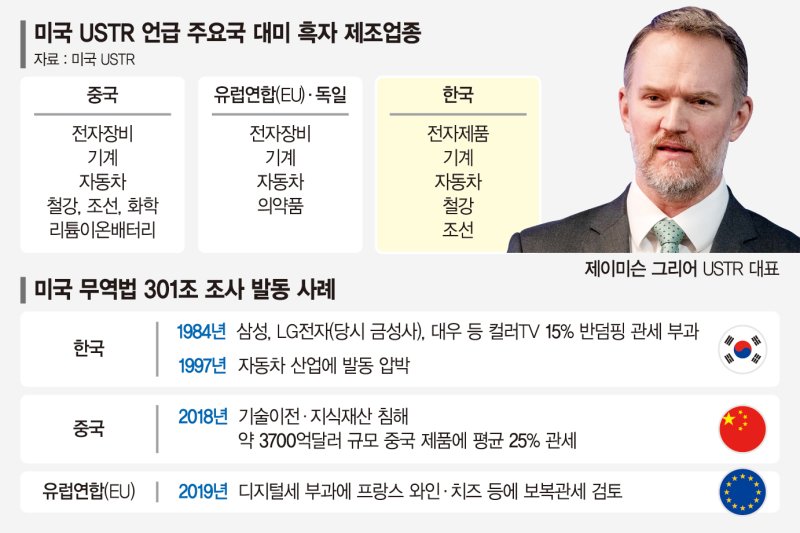
Section 301 of the Trade Act of 1974 is regarded by U.S. trading partners as a “tool of intimidation.” Once a practice is deemed unfair, Washington has historically imposed retaliation that exceeds the damage it claims to have suffered, and the scope of such measures is not confined to the sector under investigation. A prominent example is the 2017 response to China’s intellectual property violations, when the U.S. imposed an average 25% tariff on about 2,200 Chinese products.
■ "Difficult for South Korea to avoid U.S. Section 301 retaliatory tariffs"
On the 12th, several trade and industry experts pointed to the need to secure replacement tariff revenue—after mutual tariffs were struck down by a Supreme Court of the United States (SCOTUS) ruling—as the main driver behind the new Section 301 action. They noted that not only home appliances, mobile phones, and transformers, but also steel and automobiles, which are already subject to product-specific U.S. tariffs of around 15%, could be brought back to the negotiating table.
Taeho Lee, former Vice Minister at the Ministry of Foreign Affairs, stated, "It is hard to find a precedent where Section 301 investigations were launched simultaneously against as many as 16 countries," adding, "Fundamentally, this move should be seen as being driven by the goal of imposing tariffs to replace mutual tariffs."
Choi Seokyoung, former Ambassador for Economic and Trade Affairs at the Ministry of Foreign Affairs, warned, "Although Washington has announced that it is targeting manufacturing, if unfair practices are found, retaliation may not be limited to those manufacturing sectors and could be broadly expanded into non-manufacturing fields as well." He pointed out that digital services, agricultural products, and healthcare are among the many areas that could be drawn into the scope of retaliation. The Ministry of Trade, Industry and Resources (MOTIR) has explained that, aside from steel and automobiles that are already under product-specific tariffs, the sectors previously subject to mutual tariffs are likely to fall under the new Section 301 action. However, trade experts believe that in practice most industries could end up being investigated.
■ Steel and petrochemicals under close watch... Auto sector also on edge
Among the five sectors explicitly named by the U.S., many observers argue that South Korea must focus its response on steel and petrochemicals. Semiconductors are closely tied to the U.S. information technology (IT) industry, and automakers are expanding local production in the U.S., which leads analysts to conclude that steel and petrochemicals are more exposed to concentrated pressure.
Jang Sang-sik, head of the Institute for International Trade and Commerce at the Korea International Trade Association (KITA), observed, "Steel and petrochemicals appear relatively vulnerable," explaining that "these are sectors where it is easy for the U.S. to apply arguments about overcapacity, low profitability, and the need for restructuring." He went on, "The problem is that even if steel is labeled as an unfair-trade industry, past cases of Section 301 enforcement show that actual retaliation can be directed at other areas such as home appliances and automobiles that use steel as an input," and stressed, "Because this tool is effectively all-powerful, we must prepare comprehensive countermeasures in advance."
Professor Yoon Heo of Sogang University commented, "Given that the real objective is to offset the loss of mutual tariffs, there is a high likelihood that the U.S. Section 301 investigation and the imposition of retaliatory tariffs will proceed very quickly under a predetermined framework." He emphasized, "The government must respond to this Section 301 action as if it were entering a new round of trade negotiations, and do so as swiftly as possible."
Some analysts also say it is fortunate that the Korea-US Strategic Investment Special Act was passed by the National Assembly of the Republic of Korea on the same day. Cho Cheol, a research fellow at the Korea Institute for Industrial Economics & Trade (KIET), noted, "With the passage of the Korea-US Strategic Investment Special Act, South Korea has at least secured a minimal bargaining lever to adjust the scale of any tariff hikes."
[email protected] Jo Eun-hyo, Kim Hak-jae, and Kim Dong-chan Reporter