A Nonagenarian Artist with a Chainsaw: "Trees Are My Eternal Friends" [Weekend Culture]
- Input
- 2026-03-13 04:00:00
- Updated
- 2026-03-13 04:00:00
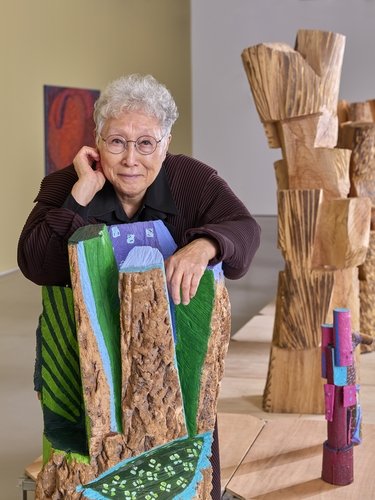
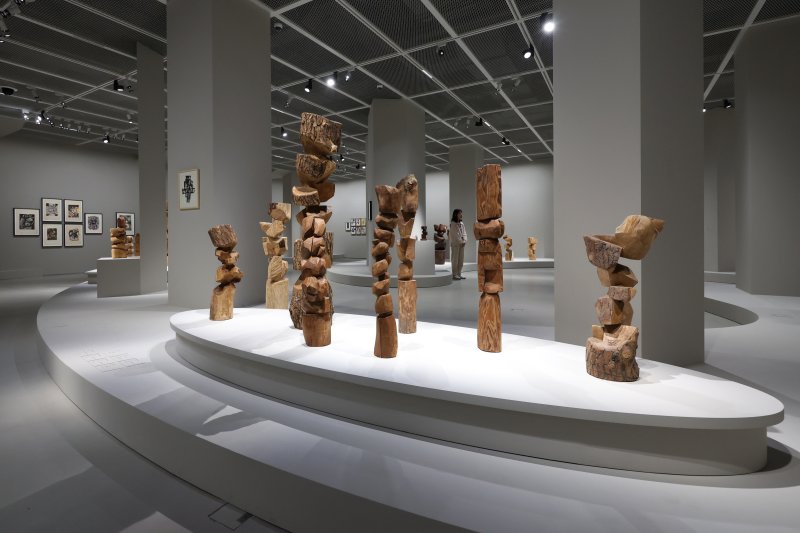
As 90-year-old Kim Yun Shin says, the exhibition space is filled entirely with wooden sculptures. Rough-hewn pieces, meticulously carved forms, and skeletal structures stripped down to their frames each radiate their own vitality. Perhaps because the artist becomes completely one with her work at every moment, the carved wood seems to gain a second life, unfolding nature anew.
A major retrospective of first-generation woman sculptor Kim Yun Shin, who laid the foundations of modern Korean sculpture and played a key role in its development, is being held in Yongin, Gyeonggi Province. Ho-Am Art Museum announced on the 12th that it will host the exhibition "Kim Yun-shin: Union into One, Division into One" through June 28.
The exhibition offers a comprehensive overview of the artist’s world, in which she has celebrated nature and life for more than 70 years. It features over 170 works that move fluidly between two-dimensional and three-dimensional forms.
At a press conference held the previous day at Ho-Am Art Museum, Kim was asked what keeps her still working with a chainsaw on wood well into her nineties. "Working is the process through which my mind and body become one," she said, adding, "Trees are my eternal friends," revealing an undiminished passion.
She has long channeled the inspiration she gained from the exotic natural environments of Argentina, Mexico, and other places into her work. Explaining why she chose wood as her primary medium, she noted, "Since childhood, trees have been friends I could communicate with," and added, "The core of my practice is to capture my own movements naturally, without going against the inherent properties of the material."
Born in 1935 in Wonsan, Gangwon Province (now in North Korea), Kim lived through the upheavals of liberation and war, leaving a distinctive mark on the Korean sculpture scene. She drew attention in the 1970s with abstract sculptures, and after moving to Argentina in the mid-1980s, she developed a unique style in which modernity and primitivism coexist, using the massive trees of South America as her material.
The core concept of the exhibition, "Union of Two into One, Division of One into Two," embodies her philosophy that artist and material meet and become one, and that through this process a new work is born.
In the first-floor gallery, the 1970s "Stacking Origins" series, along with prints and drawings from her study period in Paris, offers a view into her early formal concerns. The following section presents dynamic works from her years in Argentina, where she used a chainsaw to amplify the primal life force of wood.
In particular, the show includes works created after she moved to Argentina in 1983, in which she carved the region’s massive trees with a chainsaw. These pieces vividly reveal the raw vitality of nature and represent the peak of her artistic world.
A representative work, "2013-16 (2013)," embodies the profound emotion she felt before the grand landscapes of the Andes Mountains in Argentina. Based on a T-shaped structure, two wooden boards are set at different angles to capture the majesty of the natural world. Going beyond a simple depiction of nature, she spent several years completing the piece to fully realize her intention to express its sublimity and wonder.
Although first created in 2013, the work gradually took on its current form as Kim, true to her belief that "there is no such thing as completion," repeatedly adjusted its shape and altered its composition. Her characteristic method of revisiting and refining works over time suggests that creation is not a closed ending called completion, but an open process to which she commits herself at every moment.
On the second floor, stone sculptures are shown alongside works from the 2000s onward that incorporate the colors of the Mapuche people, an Indigenous group in Argentina. Her recent work "Singing Tree 2013-16V1 (2025)," which she calls a "painting-sculpture," combines aluminum casting with acrylic paint, clearly revealing the ongoing energy of this nonagenarian artist as she flexibly expands the boundaries between genres.
The exhibition also presents a new type of work conceived during the COVID-19 pandemic. With access to materials limited by restrictions on outdoor activity, she turned to construction debris and other discarded materials near her home, as seen in the work "2020-45." Pieces from this period take the form of sculptural paintings that seem to build abstraction into three dimensions, or conversely, painterly sculptures.
Regarding these works, Kim recalled, "As a child, I drew on trees and played with them a lot," and added, "With that same feeling, I began drawing on wood, and it became a kind of 'painterly sculpture.'"
Tae Hyun-sun, senior curator at Leeum Museum of Art who organized the exhibition, noted, "Kim is an artist who has worked as naturally as breathing, uniting art and life," and emphasized, "The marks of sawing and hammering that remain clearly visible in her works will allow viewers to experience the weight of the 'artist' as a presence, something rarely encountered in contemporary art."
Recently, Kim has continued to experiment, for example by combining color with sculpture. To younger women artists, she offered the advice that "quietly doing the work you are meant to do becomes the bedrock of society."
This exhibition surveys 60 years of her artistic career, during which she helped lay the foundations of modern Korean sculpture. It offers a chance to witness an artistic vitality that seems to be constantly renewed.
During the exhibition period, a range of related programs will be held, including an artist talk on the 27th, public lectures, and an international academic symposium. All programs require advance reservations through the Leeum Museum of Art website.
rsunjun@fnnews.com Reporter