Chinese Stocks Hold Up Despite Surging Oil Prices, Drawing Money into Green ETFs
- Input
- 2026-03-12 18:33:05
- Updated
- 2026-03-12 18:33:05
■ While Korea and Japan Stumble, China’s Market Holds Firm
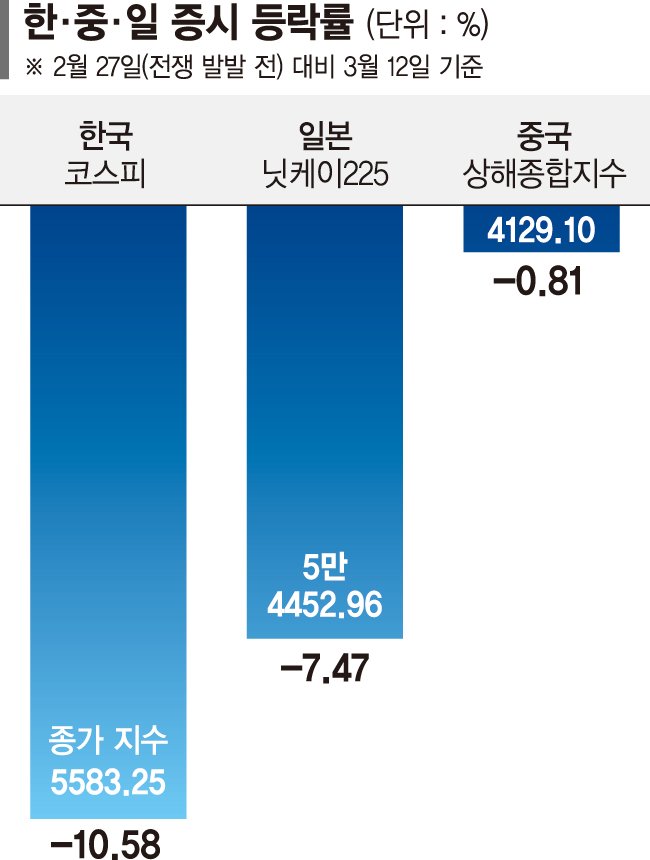
According to Investing.com on the 12th, the SSE Composite Index slipped from 4,162.88 on February 27, before the war broke out, to 4,129.10, a decline of 0.81%. Over the same period, the Korea Composite Stock Price Index (KOSPI) fell from 6,244.13 to 5,583.25, down 10.58%, and Japan’s Nikkei 225 dropped from 58,850.27 to 54,452.96, a 7.47% decline. By comparison, the Chinese market has clearly held up better.
Since the war began, the drop in China has also been milder than that of the Standard & Poor's 500 Index (S&P 500) in the United States, which is down 1.49%. In terms of volatility, the Chinese stock market has been relatively stable. The SSE Composite Index has moved an average of 0.64% per day since the conflict started, showing far smaller swings than Korea at 5.27% or Japan at 2.47% over the same period.
Experts note that, unlike Korea and Japan, which rely heavily on Middle Eastern crude, China has diversified its oil imports and is therefore less exposed to the current war’s fallout.
Baek Seok-hyun, a researcher at Shinhan Bank, said, "Unlike Korea and Japan, whose dependence on Middle Eastern crude oil is extremely high, China’s reliance is below 50%." He added, "China has diversified its import sources to Russia, Brazil, Angola and others, and in preparation for potential disruptions to sea routes, it has also built a massive overland oil and gas pipeline network running through Russia, Central Asia and Myanmar. As a result, China is suffering less damage from this war."
Global investment bank Goldman Sachs Group reaffirmed its "overweight" recommendation on Chinese equities this week. Larry Hu of Australia-based investment bank Macquarie Group also commented, "The short-term impact is limited and could ease," and projected, "Even if oil prices climb to 100 dollars per barrel, China’s consumer price inflation will likely stay around 1%."
■ Korean Retail Investors Flock to China’s Green ETFs
As oil prices surge, China’s environmentally friendly companies are emerging as beneficiaries. According to foreign media, the CSI 300 Energy Index has risen about 8% since the end of February, making it one of the best-performing major indices in China.
Among China-related exchange-traded funds (ETFs) listed on the Korean market, electric-vehicle and green-themed ETFs have delivered strong returns since the war began. Mirae Asset TIGER China EV Leverage (SYNTH) climbed from 9,380 won on February 27, before the conflict, to 10,700 won, a gain of 14.07%. That ranks seventh in performance among all ETFs. Mirae Asset TIGER China Clean Energy SOLACTIVE ETF (9.36%), TIGER China Electric Vehicle Solactive ETF (8.22%) and SOL China Solar CSI ETF (6.67%) have also maintained solid momentum since the outbreak of the war. These products hold Chinese stocks in sectors such as electric vehicles, batteries and renewable energy, which are less directly affected by oil prices.
Korean retail investors in Chinese and Hong Kong stocks are also concentrating on these themes as they follow market trends. According to Korea Securities Depository (KSD), the single most heavily bought product this month by domestic investors in the Chinese and Hong Kong markets has been the Global X China Electric Vehicle and Battery ETF listed in Hong Kong. Its net purchase settlement amount reached 21.72 million dollars (32.1 billion won), more than four times that of the second- and third-ranked products. The ETF’s portfolio includes companies such as BYD, China’s largest electric-vehicle maker, and Contemporary Amperex Technology (CATL), a major battery manufacturer.
Some observers even argue that if the war continues, the Chinese stock market could emerge as an alternative destination for global capital. Kim Kyung-hwan, a researcher at Hana Securities, stated, "China’s ability to withstand the Middle East crisis and the shock of rising oil prices is stronger than that of major Asian and eurozone economies, and inflationary pressure is very low, which also supports its currency stability." He added, "Share prices this month are still below the expected trading band for the first half of the year. Investors should view the current period of heightened volatility caused by external shocks as an opportunity to increase their exposure."
[email protected] Han Young-jun Reporter