[Editorial] U.S. now even wielding Section 301, while the Korea-U.S. investment law passes only now
- Input
- 2026-03-12 18:09:59
- Updated
- 2026-03-12 18:09:59
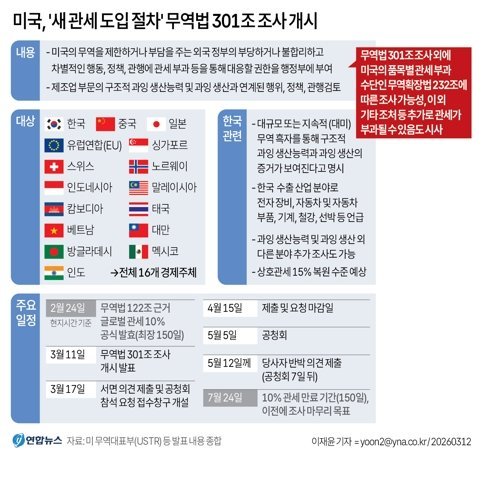
Tariffs imposed by the United States through the activation of Section 301 of the Trade Act of 1974 were expected at some point, but they now come amid a far more complex situation, compounded by the geopolitical crisis involving the Islamic Republic of Iran. The South Korean economy is already walking on thin ice due to oil and raw material shocks originating in the Middle East, and now faces renewed pressure from U.S. tariffs. In a situation where there is no clear exit from ongoing conflicts, the Trump tariffs could lead to unintended consequences. The government must not relax its vigilance until the very end.
Section 301 of the Trade Act of 1974 essentially grants the U.S. administration the authority to respond with tariffs to "unreasonable acts, policies, and practices" of foreign governments that restrict or burden U.S. trade. Its stated purpose is to curb problematic practices by foreign governments. In reality, however, Section 301 of the Trade Act of 1974 has been used as a tool for the U.S. administration to pressure other countries based on its own unilateral judgments and reasoning. The Trump administration’s latest invocation of Section 301 of the Trade Act of 1974 should be seen as an attempt to restore reciprocal tariffs whose legal force was struck down by the U.S. Supreme Court.
After the U.S. Supreme Court ruled that reciprocal tariffs imposed by the Trump administration under the International Emergency Economic Powers Act (IEEPA) were unlawful and therefore void, the Trump administration decided to maintain its existing tariff stance by turning to the Trade Act. Based on Section 122 of the Trade Act of 1974, it imposed a 10% global tariff and planned to raise that rate to 15%. However, global tariffs are temporary measures and can remain in effect for at most 150 days. The U.S. government intends to complete its Section 301 of the Trade Act of 1974 investigations within that period and thereby keep tariffs on major countries in place, but unforeseen issues could surface during the investigation process.
The U.S. side has repeatedly criticized the South Korean government for allegedly discriminating against American companies, citing, among other things, Seoul’s push to introduce an Online Platform Act. The dispute over Coupang has also not been fully resolved. U.S. investment firms holding stakes in Coupang previously petitioned the USTR to investigate what they called discriminatory measures by the South Korean government, and although they recently withdrew that petition, the issue could still be taken up in the USTR’s own investigation. With the midterm elections in November approaching, Donald Trump is under pressure to deliver visible gains such as higher tax revenues, and there is a real possibility that he will resort to excessive pressure.
The first priority must be to manage the risks posed by Donald Trump’s unpredictability and to avoid giving Washington any pretext to seize on. Last year, our government reached a tariff agreement with the United States, pledging 350 billion dollars in investment in the U.S. in exchange for Washington lowering the previously announced 25% reciprocal tariffs to 15%. However, when passage of the Korea-US Strategic Investment Special Act, needed to implement the 350 billion dollars in U.S.-bound investment, was delayed, Washington unilaterally announced a plan to restore tariffs on that basis. It was an issue that could have been resolved through sufficient dialogue between the two governments, but the Trump administration took a different approach. In this urgent situation, the political establishment bears undeniable responsibility for only now passing the Special Act for Korea-U.S. Strategic Investment Management. If South Korea alone ends up facing additional tariffs, the damage to our industrial competitiveness could be devastating. The government, the political class, and businesses must close ranks to overcome this daunting wave of tariffs.