Government Sets Maximum Fuel Prices, Cutting Gasoline and Diesel by About 100 Won per Liter
- Input
- 2026-03-12 20:19:53
- Updated
- 2026-03-12 20:19:53
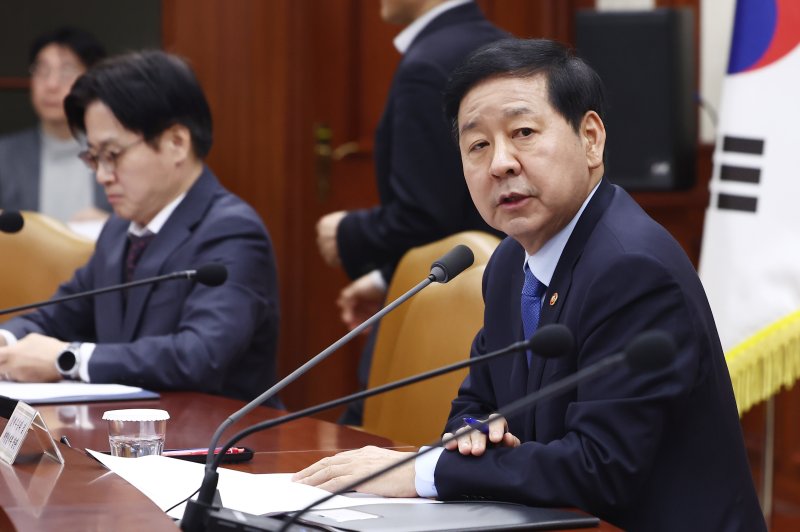
According to The Financial News, the Government of South Korea will enforce a maximum price system for petroleum products from midnight on the 13th, in response to the surge in global oil prices triggered by the war in the Middle East. Except for some island regions, wholesale prices charged by oil refining companies to about 13,000 gas stations nationwide will be fixed for two weeks at 1,724 won per liter for regular gasoline and 1,713 won for automotive diesel. After that period, new maximum prices will be set again. Compared with recent market prices, consumers will effectively receive a discount of more than 100 won per liter. The government plans to cover the losses incurred by refiners with fiscal funds.
This maximum price designation for petroleum products, revived after 30 years, is a very strong price-stabilization tool because it directly controls the supply prices of oil refining companies at the upper tier of the distribution chain, on the premise of government fiscal support. At the same time, the government on the 13th also activated a measure banning hoarding of petroleum products, such as stockpiling for speculative resale, which can be subject to criminal penalties if violated.
The government has previously taken broad measures to stabilize prices in response to external shocks. However, experts say it is unusual to mobilize all available administrative powers at such speed and to control prices at the highest level allowed by law, as is being done this time. To secure the fiscal resources needed for price stabilization, including compensation for oil refiners’ losses, the government also plans to move quickly to draw up an extra budget between April and May.
On the 12th, the government suddenly designated maximum prices for petroleum products and announced that the measure would take effect from midnight on the 13th.
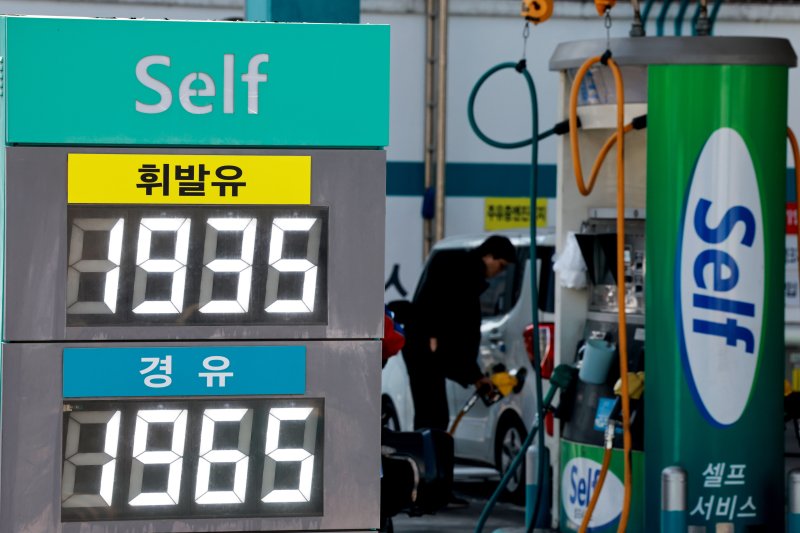
The maximum prices per liter are set at 1,724 won for regular gasoline, 1,713 won for automotive diesel, and 1,320 won for indoor kerosene. For petroleum products supplied to island regions, the ceiling is 10 to 19 won higher. This means oil refining companies cannot sell to gas stations at prices above these levels. Gas stations then add their own margins on top of the ceiling price, taking into account rent, labor costs, and other expenses. In practice, consumers are expected to pay slightly more than the maximum wholesale price for gasoline and kerosene at the pump. Even so, given that consumer prices have approached 2,000 won per liter since the Middle East crisis began, the measure will lower prices by more than 100 won per liter.
The measure effectively caps the supply prices of oil refining companies at the upper end of the distribution structure. Because refiners will be compensated for their costs, they are unlikely to suffer significant net losses. All of this support will come from government finances, that is, tax revenue. While the exact amount will depend on international oil prices and the duration of the program, the losses are estimated to be at least in the tens of billions of won.
The reference price is based on the weekly pre-tax supply prices of oil refining companies. This reflects the actual average prices at which refiners supply fuel to gas stations and distributors. To this base, the government applies the rate of change in oil prices and then adds taxes such as the transportation, energy and environment tax and the individual consumption tax. As of the morning of the 12th, the average domestic price was 1,903 won per liter for gasoline and 1,924 won for diesel. Compared with March 27, just before the Middle East crisis erupted, these prices have jumped by 210 won and 332 won respectively. Prices had risen for 10 consecutive days this month, with sharp increases of more than 4% between the 3rd and 5th, before the government’s move to set maximum prices helped cool the upward trend.
These maximum prices will be updated every two weeks to reflect changes in oil prices.
Yang Ki-uk, Director-General for Industrial and Resource Security at the Ministry of Trade, Industry and Energy of the Republic of Korea, stated, "We have limited the implementation period of the maximum price system to two months, and we will assess the situation flexibly in light of oil price developments, including the crisis in the Middle East," adding, "If necessary for price stability, we can also change the two-week adjustment cycle."
In effect, the government is cutting retail prices for petroleum products, while covering the resulting losses with public funds. Oil refining companies will calculate their losses based on their own cost structures and then request settlement from the government. The government will review these claims through the Maximum Price Settlement Committee and reimburse the verified amounts.
Assistant Vice Minister for Finance and Economy Kang Giryong said, "Along with compensating for losses arising from the maximum price designation, we are also pursuing a fuel tax cut and direct support for vulnerable groups," and added, "We are exploring ways to secure the necessary fiscal resources for these measures."
Some observers warn that if the maximum fuel price regime is prolonged, gas stations may resort to tactics such as reducing retail volumes or shortening business hours to protect their margins. Friction is also expected over how refiners prove their costs when calculating losses for compensation.
For this reason, the government has invoked the Price Stabilization Act and, alongside the maximum price designation, issued a notice banning hoarding of petroleum products by refiners and gas stations, such as stockpiling for speculative gains.
The maximum price system for petroleum products is being revived for the first time in 30 years. Since oil prices were liberalized in 1997, it has never been implemented. However, on the 5th, President Lee Jae-myung, President of the Republic of Korea, criticized what he called one-shot profiteering by some gas stations that sharply raised fuel prices in a single day under cover of the war, and ordered the swift introduction of the maximum price system, saying, "The situation regarding energy supply and household anxiety is grave."
Economic authorities then moved quickly. The system is being implemented just one week after the president’s order and 12 days after the outbreak of war between the United States of America (U.S.) and the Islamic Republic of Iran (Iran). In this context, Deputy Prime Minister for Economic Affairs and Minister of Finance and Economy Koo Yun-cheol wrote on social networking service (SNS) on the same day, "The government is responding in a way that surpasses past practices and speeds."
Alongside the maximum price designation, the government plans to expand supply by releasing oil from strategic reserves. It is also preparing direct emergency livelihood support for energy-vulnerable households. In addition, it is ready to further cut the fuel tax, which is currently reduced by up to 10% (7% for gasoline and 10% for diesel), down to the legal maximum reduction of 37%.
At the same time, the government is intensively deploying all available tools to rein in essential consumer prices.
The Korea Fair Trade Commission (KFTC) plans to complete, as quickly as possible within the first half of the year, its largest-ever cartel enforcement cases involving sugar, wheat flour and starch-based sweeteners. In response to the ongoing cartel investigation, sugar manufacturing companies, flour milling companies, starch-based sweeteners producers, as well as bakeries and ramen manufacturers, have already cut consumer prices by up to 6%.
Authorities are also cracking down on scalpers reselling tickets for the upcoming BTS concert in Gwanghwamun, and have designated 23 items, including pork, as key essential consumer goods subject to special price monitoring.
[email protected] Jeong Sang-geun, Park Ji-young, Seo Young-jun, Kim Chan-mi Reporter