Criminal complaints filed against judges following enforcement of new offense of distorting the law: "Undermining judicial independence"
- Input
- 2026-03-12 15:52:07
- Updated
- 2026-03-12 15:52:07
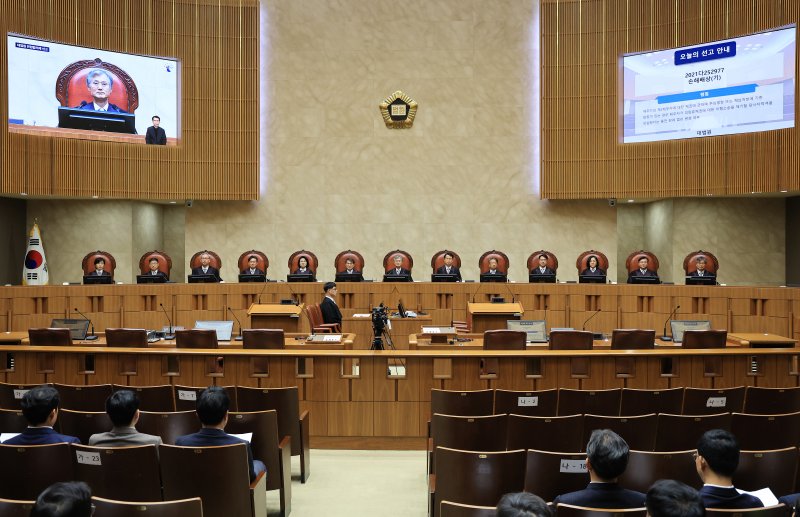
According to the Government Gazette, the government on that day promulgated the crime of distorting the law (a newly established Article 123-2 of the Criminal Act), the constitutional complaint against court rulings (an amendment to the Constitutional Court Act), and the Expansion of Supreme Court Justices (an amendment to the Court Organization Act). Under the crime of distorting the law, judges, prosecutors, police officers, and others engaged in criminal proceedings can be punished if they "know that the requirements for applying a statute are not met but apply it anyway, or know that a statute should be applied but intentionally fail to apply it, thereby deliberately influencing the outcome of a trial or investigation." In other words, it is a provision that allows criminal punishment for judges, prosecutors, and police officers simply for the way they perform their official duties. If found guilty, they face up to 10 years in prison or up to 10 years of disqualification from office.
A criminal complaint against a judge was filed as soon as the crime of distorting the law took effect. According to the legal community, attorney Lee Byung-cheol of IA Law Firm submitted a complaint on the 2nd to the National Office of Investigation, seeking punishment under the crime of distorting the law for Chief Justice Cho Hee-dae and Supreme Court Justice Park Young-jae, who last May remanded to a lower court the Public Official Election Act violation case of President Lee Jae-myung of South Korea. On the same day, he also filed a complaint with the Corruption Investigation Office for High-ranking Officials (CIO), accusing Chief Justice Cho and others of abuse of authority and dereliction of duty.
In his complaint, Lee argued, "Chief Justice Cho and the others, as judges involved in a criminal trial, intentionally influenced the outcome of the case by failing to apply a statute they knew should be applied to the criminal case pending against another person (President Lee), with the purpose of harming his rights and interests." Police stated that the case has been assigned to Yongin Seobu Police Station in Gyeonggi Province.
Some observers say that the mere existence of the crime of distorting the law will weigh on judges, prosecutors, and police officers, prompting them to exercise greater caution in performing their duties. Others note that, in practice, it will be very difficult to prove that the law was intentionally distorted, and therefore unlikely that the offense will often be recognized in court.
However, many in the legal community are wary of the threat posed by criminal punishment. Because the crime of distorting the law allows criminal sanctions for the way judges and prosecutors carry out their duties, they argue it infringes on the independence and professional judgment required in their work.
One senior presiding judge questioned, "Is it appropriate and reasonable to use criminal punishment—a means that concerns a person’s very life and death—to instill a sense of caution?" The judge continued, "When a judge is summoned for questioning by an investigative agency, they go not as a judge but as a private individual, so it is inevitable that they will feel intimidated," adding, "Even under current law, a judge’s status is protected so that they can carry out their judicial duties without bowing to political or economic power. The crime of distorting the law violates this legal principle by imposing measures not on status but on personal liberty."
Another legal professional, a former judge, said, "People may challenge the Judiciary’s decisions, but because the Judiciary is an institution that maintains social order, society must show a certain degree of respect for its authority." The former judge added, "By its nature, a court ruling is something that is hard for everyone to be satisfied with. If people go so far as to seek criminal punishment simply because they dislike a decision, society will become unstable."
The former judge went on to say, "In the course of adjudication, what must be considered first is the law, not social sentiment. If the content of the law runs counter to social sentiment, that is an issue for the legislature, not the Judiciary, to resolve," and added, "Judges guarantee social stability by performing their duties on the basis of law, which is a pre-agreed and codified order."
[email protected] Reporter Kim Dong-gyu Reporter