Korea-U.S. Strategic Investment Special Act Passes National Assembly: Will It Ease U.S. Tariff Risks?
- Input
- 2026-03-12 15:41:50
- Updated
- 2026-03-12 15:41:50
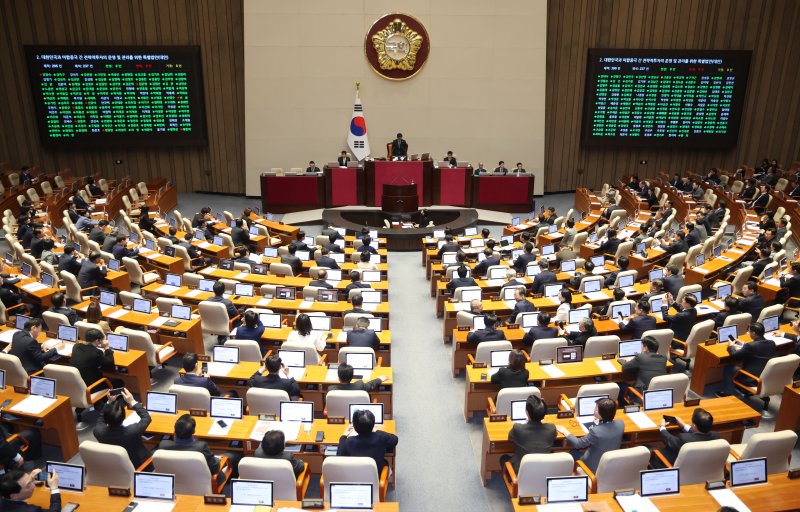
[Financial News] The "Special Act on the Operation and Management of Strategic Investment between the Republic of Korea (ROK) and the United States of America (US)" (Korea-U.S. Strategic Investment Special Act) has cleared the plenary session of the National Assembly of the Republic of Korea with bipartisan agreement. Mounting pressure from U.S. President Donald John Trump to reimpose higher tariffs prompted rare cooperation between the ruling and opposition parties. With a legal basis now in place for ROK’s planned US$350 billion (about 510 trillion won) investment in the US, attention is focused on whether the associated U.S. tariff risks will be eased.
On the 12th, the National Assembly of the Republic of Korea convened a plenary session and passed the Korea-U.S. Strategic Investment Special Act. Under this act, the Korea-U.S. Strategic Investment Corporation will be established to handle ROK’s strategic investments in the US. Within the corporation, the Korea-U.S. Strategic Investment Fund will be created, and its resources will be raised through capital contributions to the corporation, entrusted assets, and the issuance of Korea-U.S. strategic investment bonds. The act also defines a standard of "commercial reasonableness" for investments in the US and requires prior approval from the National Assembly of the Republic of Korea if any such investment is pursued without securing this commercial rationale.
Having completed the major task of passing the Korea-U.S. Strategic Investment Special Act, the National Assembly of the Republic of Korea is expected to move on to follow-up measures. The Korea-U.S. Parliamentary Association, a bipartisan lawmakers’ group, plans to visit the US on the 23rd to explain the details of the special act. It also intends to discuss specific sectors and projects for investment in the US.
Issues raised by the US regarding alleged unfair practices by digital companies will also require further discussion. Lawmakers must first address the planned overhaul of the Online Platform Act and the Online Platform Fairness Act. Washington views the proposed regulation of U.S. big tech firms in these bills, which are pending in the National Assembly of the Republic of Korea, as potentially discriminatory. Because retaliatory tariff hikes are on the table, the relevant provisions are expected to undergo close scrutiny.
The Trump administration’s decision to launch a "Section 301 of the Trade Act of 1974" investigation—a procedure to impose additional tariffs on 16 economic entities, including ROK, China, and Japan—poses a serious challenge for ROK. As this is a preliminary step toward restoring reciprocal tariffs, the outlook has darkened. Although the passage of the Korea-U.S. Strategic Investment Special Act is expected to accelerate discussions on concrete investment projects in the US, the risk of renewed U.S. tariff hikes remains.
Meanwhile, the National Assembly of the Republic of Korea passed about 50 livelihood and reform-related bills at the plenary session that day. These included an amendment to the Act on Promotion of Information and Communications Network Utilization and Information Protection to better respond to voice phishing (vishing), and an amendment to the Emergency Medical Service Act aimed at reducing regional disparities in emergency medical services. In addition, Representative Jin Sung-joon was elected as Chairperson of the Special Committee on Budget and Accounts of the National Assembly, a post that had been vacant. The request for a "Parliamentary Investigation into Alleged Fabricated Indictments by Political Prosecutors under the Yoon Suk Yeol Administration" was also formally reported. This Investigation of State Administration will cover seven cases, including President Lee Jae-myung’s Daejang-dong, Wirye New Town, and alleged remittances to North Korea cases; the political funds case involving Kim Yong, former deputy head of the Institute for Democracy and a close aide to the president; the Moon Jae-in administration’s alleged manipulation of real estate statistics; the West Sea civil servant shooting incident; and the defamation case involving former President Yoon Suk Yeol related to reports that he helped quash an investigation into Busan Savings Bank.
By contrast, the Special Acts on Administrative Integration for Daegu–Gyeongbuk (Daegu–Gyeongbuk (TK)) and Daejeon and South Chungcheong Province ultimately failed to clear the plenary hurdle. There had been a shared understanding that these bills should be passed during the March extraordinary session, before the local elections, but observers now say it will be difficult to move them forward under current conditions. Song Eon-seok, floor leader of the People Power Party (PPP), called for the immediate passage of the TK integration bill and proposed forming the Special Committee on Administrative Reorganization of the National Assembly to discuss integration in other regions such as Daejeon and South Chungcheong Province.
[email protected] Lee Hae-ram, Kim Hyeong-gu Reporter