[First Day of Constitutional Complaints and Judicial Distortion Offense] Legal Community in Turmoil... Fast-Track Push Even Toward Reviving the State Bar Exam?
- Input
- 2026-03-12 14:57:56
- Updated
- 2026-03-12 14:57:56
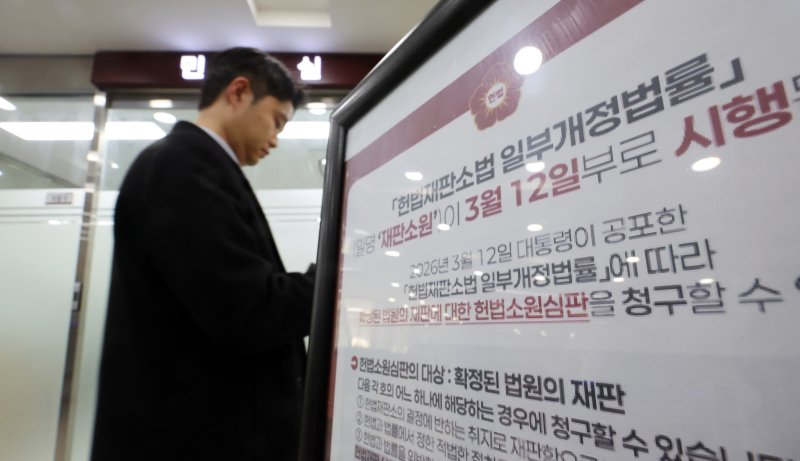
The Financial News: On the first day that the system of filing a constitutional complaint against court rulings and the new judicial distortion offense, which punishes wrongful decisions by judges and prosecutors, came into force, the legal community was thrown into confusion. Chief Justice of the Supreme Court of Korea Cho Hee-dae, the head of the Judiciary who sparked controversy by handling President Lee Jae-myung of South Korea’s case in just one month, was reported to prosecutors on charges under the judicial distortion offense. Refugee cases and delayed state compensation cases were also filed one after another as constitutional complaints against court rulings. On top of this, the presidential office (Cheong Wa Dae) has hinted at the possibility of reviving the state bar examination, accelerating what appears to be a broad reform drive across the legal sector.
■ Complaints and filings from day one... Even Cho Hee-dae was not spared
According to the legal community on the 12th, on the very first day the judicial distortion offense took effect, Chief Justice of the Supreme Court of Korea Cho Hee-dae, the head of the Judiciary, was reported on that charge. Attorney Lee Byung-cheol of IA Law Firm stated that on the 2nd he filed a complaint with the National Office of Investigation accusing Chief Justice Cho and former Minister of the National Court Administration Supreme Court Justice Park Young-jae of the judicial distortion offense. Although this was before the offense formally came into force, he filed the complaint in advance, asking that an investigation begin immediately once the law became effective.
Chief Justice Cho and former Minister of the National Court Administration Park last May overturned an appellate court’s acquittal of President Lee on charges of violating the Public Official Election Act and remanded the case. Attorney Lee argued that they had a “legal duty to act” to print out, review, deliberate, and decide on some 70,000 pages of paper records, yet they did not properly examine them and still reached a conclusion in just 34 days. The case drew criticism at the time that the Judiciary was trying to intervene in the presidential election and politics. The investigation into this matter is scheduled to be conducted by Yongin Seobu Police Station in Gyeonggi Province.
According to the Constitutional Court of Korea, as of 2 p.m. that day, a total of 11 constitutional complaints against court rulings had been filed, including the first case, which challenges a deportation order and protection order issued against a Syrian refugee. As filings are still being submitted, the number is expected to rise quickly.
With constitutional complaints against court rulings and reports under the judicial distortion offense now in full swing, some warn that they may be overused in the future. Yang Moon-seok, a lawmaker from the Democratic Party of Korea who was stripped of his seat by a Supreme Court of Korea ruling that day, said he would review the judgment and then file a constitutional complaint against court rulings. As law firms have begun setting up dedicated teams for such complaints, the number of filings is expected to climb rapidly toward the 10,000 cases projected by the Constitutional Court of Korea. The Judiciary, for its part, has placed constitutional complaints and the judicial distortion offense on the agenda of the regular two-day National Conference of Court Presidents starting that day and is struggling to devise a response.
■ Revival of the state bar examination? Official denials, but questions remain
Meanwhile, speculation has emerged that the state bar examination, which was abolished in 2017, could be reintroduced, raising the prospect that reforms across the legal community may accelerate.
The previous day, one media outlet reported that the presidential office was reviewing the reintroduction of the state bar examination. Under the reported plan, 100 to 150 people a year would be selected through the exam, while law schools under the graduate law school system would remain in place. The presidential office and the Ministry of Justice immediately denied the report. The presidential office, in a statement issued under the name of spokesperson Kang Yu-jeong, said, "It is not true," and the Ministry of Justice echoed the same position.
However, some observers still see a strong possibility that the state bar examination will be revived despite the denials from the presidential office and the Ministry of Justice. They point out that President Lee Jae-myung of South Korea publicly expressed views on the problems of the current law school system last June. At the time, when a participant asked him to "bring back the state bar examination," he replied, "If someone has the ability, shouldn’t we be able to grant a license to practice law through some form of assessment even if they have not graduated from a law school?"
A source in the legal community predicted, "Since the president has revealed his thinking, it may not happen immediately, but it could ignite the issue."
[email protected] Reporter Jung Kyung-soo Reporter