English kindergartens face closure if they use level tests
- Input
- 2026-03-12 15:27:58
- Updated
- 2026-03-12 15:27:58
[Financial News] Level tests for children seeking admission to so-called "English kindergartens" will be completely banned. Election campaigning that uses artificial intelligence (AI) deepfakes in superintendent of education races will also be strictly restricted.
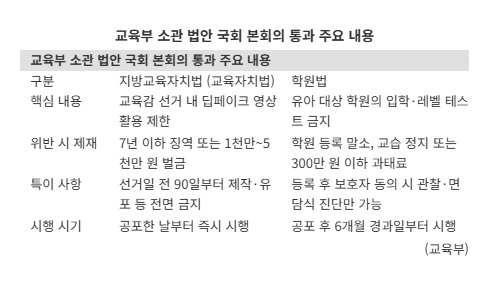
The Ministry of Education announced on the 12th that amendments to the Act on the Establishment and Operation of Private Teaching Institutes and Extracurricular Lessons, which blocks entrance exams at private institutes for young children, and to the Local Education Autonomy Act, which punishes the use of fake videos that undermine election fairness, were each passed at the plenary session of the National Assembly of the Republic of Korea. With the passage of these bills, excessive competition for admission among preschool-age children is expected to ease. The amendments also create a legal basis to protect elections for heads of education administrations from technology-driven disinformation.
The amended Act on the Establishment and Operation of Private Teaching Institutes and Extracurricular Lessons essentially bans all types of tests and evaluations that private institutes for young children have used to recruit new students or assign them to different-level classes. The change is intended to put an end to the controversy over harsh "level tests" that forced three- and four-year-olds to sit demanding exams just to enter so-called English kindergartens. Not only written tests but also oral exams that make young children anxious or pressure them to give the correct answer are regarded as prohibited evaluation practices.
Private institutes that ignore the ban and continue to administer such tests will face strong sanctions. The superintendent of education may revoke the institute’s registration or order a suspension of instruction for up to one year, and may also impose an administrative fine of up to 3 million won. However, diagnostic activities such as observation or interviews conducted after a child is enrolled, with the consent of the guardian, will be exceptionally permitted. The amendment will take effect six months after its promulgation.
The amended Local Education Autonomy Act, passed at the same time, focuses on ensuring the fairness of superintendent of education elections. Its core is to apply the deepfake restrictions under the Public Official Election Act to superintendent of education races in the same way. Accordingly, from 90 days before election day until election day, it will be completely prohibited to produce, edit, distribute, or post deepfake videos for electioneering purposes.
Penalties for violations are very severe. Offenders may face up to seven years in prison or a fine between 10 million and 50 million won. Even earlier than 90 days before the election, anyone who fails to clearly indicate that a video is AI-generated and manipulated may be punished by up to five years in prison or a fine of up to 50 million won. This amendment will take effect immediately upon promulgation.
monarch@fnnews.com Kim Man-gi Reporter