Signs of Conflict Over Petrochemical Industry Restructuring...Unions Say "Support Only for Companies, No Employment Measures"
- Input
- 2026-03-12 12:56:48
- Updated
- 2026-03-12 12:56:48
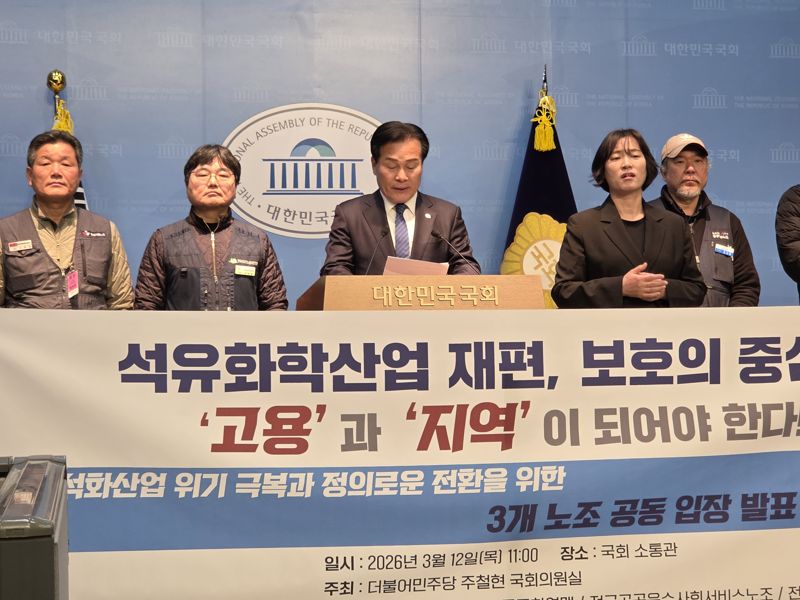
The Financial News: As the government pushes ahead with restructuring the petrochemical industry, labor groups are calling for measures to protect jobs, raising the prospect of conflict. Critics argue that the restructuring policy focuses on improving corporate finances while falling short on safeguards for workers' employment and local economies.
A press conference hosted by the office of Democratic Party of Korea lawmaker Joo Cheol-hyeon and co-organized by the National Construction Industry Trade Union Federation, the Korean Public Service and Transport Workers' Union, and the Korean Federation of Chemical, Textile and Food Industry Workers' Unions was held on the 12th at the National Assembly Communication Center. The unions announced a "Joint List of Demands by Three Industrial Unions for Overcoming the Petrochemical Industry Crisis and Ensuring a Just Transition."
Labor groups criticized the government's ongoing petrochemical industry restructuring policy as being centered on corporate support. Last month, the government approved the "Daesan No. 1 Project" restructuring plan and announced support measures including financial assistance, tax relief, streamlined licensing procedures, and reduced raw material cost burdens.
The unions argued, "Government support is focused on improving companies' financial structures, while measures to ensure job security for workers and protect local commercial districts are effectively missing," adding, "We cannot accept an industrial restructuring policy that is not premised on maintaining employment."
Joo Cheol-hyeon, who represents Yeosu-si Gap, Jeollanam-do, where a major petrochemical industrial complex is located, also voiced concern. Joo stated, "The government's approval of petrochemical industry restructuring is focused solely on improving corporate finances, and worker job security and protection of local commercial districts still rely on outdated 'trickle-down' assumptions," and added, "We need a comprehensive plan that protects workers and local communities."
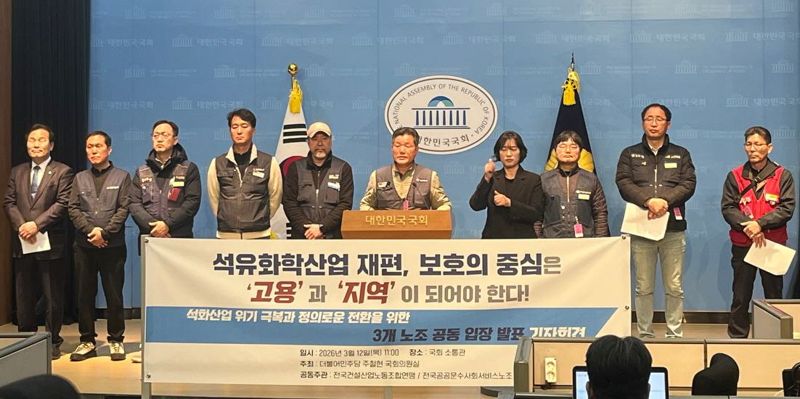
Voices from frontline workers describing their difficulties also followed. Kim Seon-jong, vice chair of the Korean Public Service and Transport Workers' Union (KPTU), said, "Due to reduced shipments from companies in the Yeosu National Industrial Complex, freight workers' revenue has fallen by 54–80%," and lamented, "If the decline in cargo volume continues, we will soon be worrying about how to make a living next month."
Shin Hwan-seop, head of the Korean Chemical, Textile and Food Industry Workers' Union, stressed, "Unlike Ulsan Metropolitan City or Daesan, the Yeosu National Industrial Complex is structured around the chemical industry, so if an industrial transition strategy is not prepared, serious damage will occur and the city could become hollowed out," adding, "We cannot agree to restructuring that excludes labor."
At the press conference, the unions called for: making "total employment retention" mandatory, including in-house subcontractors and partner firms; creating jobs by improving aging industrial complex infrastructure; and designating special zones for a just transition. They also argued that, during petrochemical industry restructuring, a consultative body involving workers and local communities should be established, and that a joint training center is needed to support transition into new industries such as hydrogen, ammonia, and Carbon Capture, Utilization and Storage (CCUS).
The unions further stated, "Because the petrochemical industry is a key national industry, its collapse could not only lead to the decline of local regions but also deliver a major shock to the national economy," and added, "We need a comprehensive plan for industrial restructuring that centers on protecting workers' jobs and local communities."
They also announced plans to launch broader actions, starting with the "Yeosu National Industrial Complex Preservation Citizens' Rally" to be held in Yeosu on the 21st, followed by a nationwide struggle on May 16.
solidkjy@fnnews.com Reporter Koo Ja-yoon Reporter