Signs of USFK asset movements... Military says, "No problem with deterrence, planned drills proceeding"
- Input
- 2026-03-12 12:55:36
- Updated
- 2026-03-12 12:55:36
On the 12th, Deputy Spokesperson Lee Kyung-ho of the Ministry of National Defense of the Republic of Korea said at a regular briefing in the morning, "We ask again for your understanding that it is difficult to provide detailed explanations regarding combined force operations between South Korea and the United States," conveying this position.
He went on, "We are constantly keeping a close watch on the Democratic People's Republic of Korea (North Korea) and managing the situation well," adding, "Senior officials of South Korea and the United States are communicating and consulting closely, and because we maintain a combined defense posture, there is no problem with deterrence against the North."
Regarding whether outdoor maneuver training has been reduced or canceled due to the possible redeployment of USFK assets to the Middle East, Lee added, "As far as I know, the planned drills are being conducted as scheduled."
The Ministry of National Defense of the Republic of Korea has repeatedly stated that "the mission of United States Forces Korea (USFK) is to maintain the combined defense posture and contribute to peace on the Korean Peninsula," and that "South Korea–United States authorities will continue close communication and coordination."
USFK also stated, "For operational security reasons, we will not comment on the movement, repositioning, or potential repositioning of specific military capabilities or assets," while emphasizing, "The United States continues to maintain its firm commitment to the defense of the Republic of Korea."
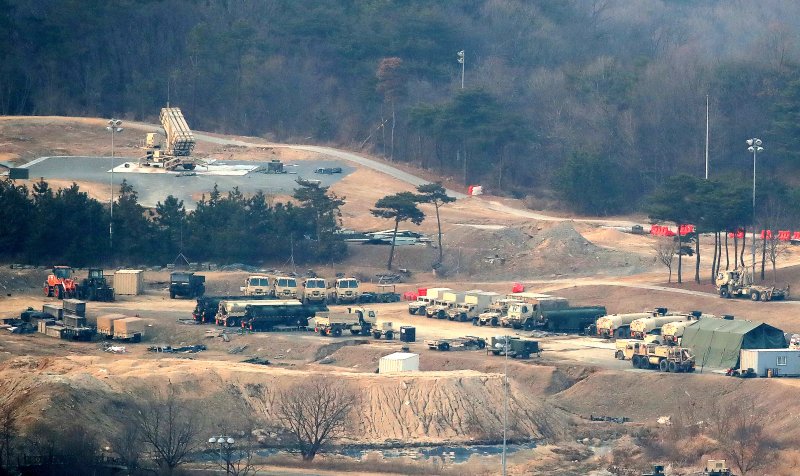
Earlier, USFK moved equipment such as MIM-104 Patriot batteries that had been deployed at several bases in South Korea, as well as large transport aircraft including the Lockheed C-5 Galaxy and the Boeing C-17 Globemaster III, to Osan Air Base. Some of the Boeing C-17 Globemaster III aircraft stationed at Osan left South Korea between the 5th and 6th, flew to the United States, and then appeared over Europe and the Mediterranean. This has led to reports that USFK’s air-defense assets are being steadily redeployed to the Middle East.
On the 3rd, a convoy that included six launchers from the Terminal High Altitude Area Defense (THAAD) battery deployed at the Seongju base in North Gyeongsang Province left the base and has reportedly not returned to Seongju to date. However, the mobile radar and fire-control center that make up the THAAD battery are said to remain at the Seongju base. Foreign media outlets, including The Washington Post (WP), have reported that some of the THAAD launchers in USFK’s air-defense network are being moved to the Middle East.
South Korea and the United States are currently conducting their first-half combined exercise, Freedom Shield (FS), from the 9th through the 19th.
[email protected] Lee Jong-yoon Reporter