First Constitutional Complaint Against Court Rulings Concerns 'Syrian Deportation Order Case'... Four Filings as of 9 a.m.
- Input
- 2026-03-12 11:30:42
- Updated
- 2026-03-12 11:30:42
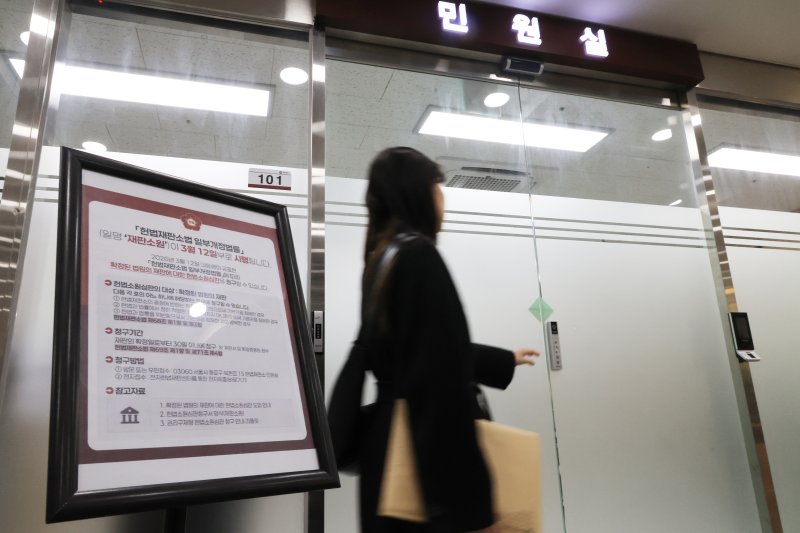
Financial News – The first constitutional complaint against court rulings filed to seek a fresh review of a Supreme Court of Korea judgment has been recorded as the Syrian Deportation Order Case.
The Constitutional Court of Korea announced on the 12th that the first case has been designated as the "Case on the Revocation of Deportation and Detention Orders Against a Syrian National" and that, as of 9 a.m., four constitutional complaints against court rulings had been filed. All four complaints were submitted online.
The first constitutional complaint against court rulings, the "Case on the Revocation of Deportation and Detention Orders Against a Syrian National," was filed online at 12:10 a.m. that day. The case involves a final judgment by the Supreme Court of Korea, which is also named as the respondent. It concerns a lawsuit brought by a Syrian national against the immigration authorities, in which the Supreme Court of Korea rejected his request to revoke a deportation order and a detention order issued against him.
The second case is the "Case on the Annulment of the Dismissal of a State Compensation Claim for Delay in Criminal Compensation," filed by bereaved family members of abducted-and-returned fishermen. It was filed at 12:16 a.m. the same day, and the respondent is the Seoul Central District Court.
The bereaved family of the late Kim Dal-su, an abducted fisherman, had been branded as spies and punished, but in January 2023—50 years later—they were acquitted in a retrial. Afterward, in April of the same year, the family applied for criminal compensation to the Gangneung Branch of Chuncheon District Court. Criminal compensation is a system under which the state compensates defendants who have been finally acquitted for damage caused by detention or trial, and the court must decide on compensation within six months of receiving the application.
The court issued its criminal compensation decision in July 2024, the following year. The family then filed a state compensation lawsuit over the delay, arguing that the deadline for deciding on their criminal compensation claim had been exceeded, but both the first and second instance courts ruled against them, holding that the deadline was only a directory provision. Because the case was classified as a small-claims case, an appeal to the Supreme Court of Korea was not allowed, and the second-instance judgment became final on the 20th of last month.
With the constitutional complaint against court rulings published in the Government Gazette that day, the system has now fully taken effect. Under this system, a constitutional complaint against court rulings may be filed within 30 days of a final judgment only if the court’s decision contradicts the purport of a ruling by the Constitutional Court of Korea, if the court failed to follow due process prescribed by the Constitution and statutes, or if the court clearly violated the Constitution or statutes and thereby infringed a fundamental right.
If the Constitutional Court of Korea finds a problem with a court’s decision, the judgment in question will be annulled, and the relevant court must conduct a new trial in line with the Constitutional Court of Korea’s ruling.
[email protected] Jung Kyung-soo and Choi Eun-sol Reporter