KDI warns of possible U.S.–Iran war: “Rising oil prices are a downside risk for consumption and the economy”
- Input
- 2026-03-12 12:00:00
- Updated
- 2026-03-12 12:00:00
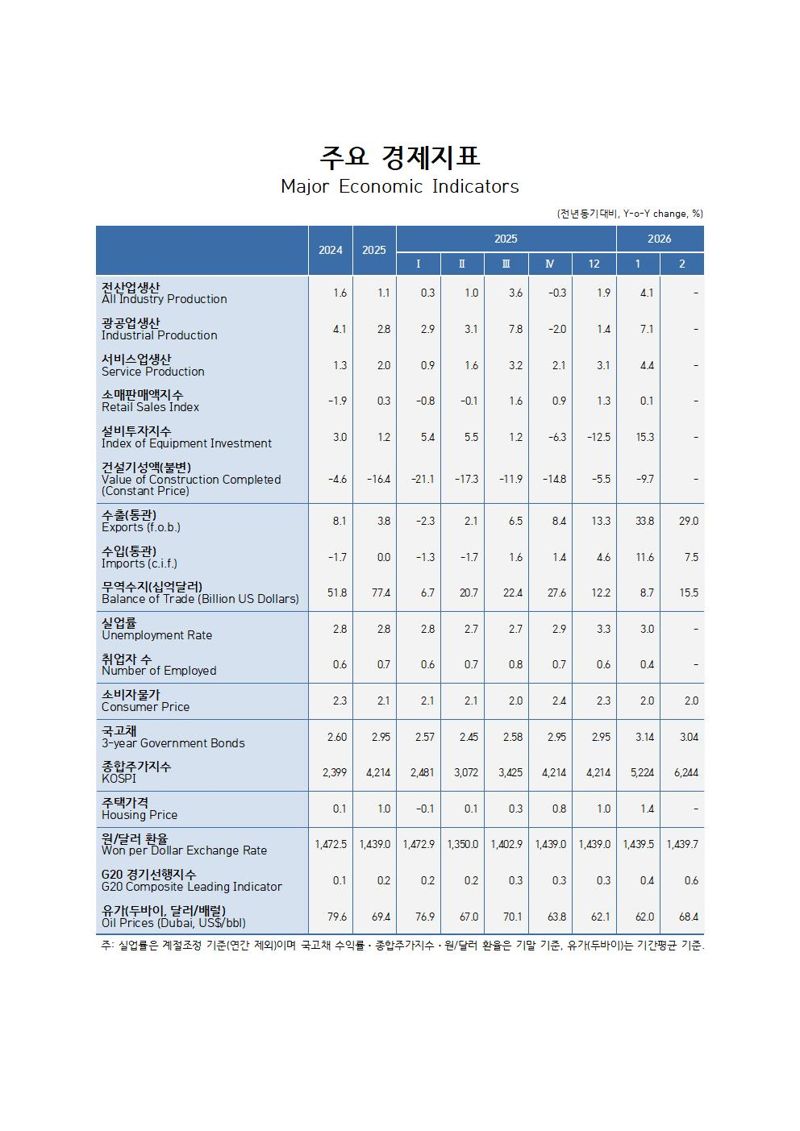
According to The Financial News, Korea Development Institute (KDI) recently warned that if a war breaks out between the United States of America (U.S.) and the Islamic Republic of Iran, a sharp rise in oil prices could push up consumer prices in Korea. This could reverse the current pattern in which improving consumption and stronger services output are driving overall industrial production.
In its March issue of Economic Trends released on the 12th, KDI assessed, “Recently, our economy has continued to benefit from strong semiconductor performance and a recovery in consumption, but overall production growth remains modest due to weakness in the construction sector.” It added, “Export values are maintaining a solid trend, mainly in Information and Communication Technology (ICT) items, but this has not yet translated into a meaningful increase in production volume.” The institute further noted, “Despite sluggishness in other categories, a surge in semiconductor export values is leading overall export growth,” and analyzed, “Demand for semiconductors has jumped, but supply capacity is still constrained, causing prices to spike, while production growth in manufacturing excluding semiconductors remains somewhat weak.”
The “improvement in consumption” that KDI has been highlighting since January this year was reiterated again this month. KDI stated, “Service-sector output showed a favorable trend on the back of improving consumption, whereas the slump in construction investment appears to be prolonged,” and added, “Consumption continued a modest recovery as real purchasing power improved.” At the same time, it warned, “External uncertainty has increased, including a sharp rise in international oil prices following the outbreak of war in the Middle East,” and projected, “Given the high uncertainty over how the Middle East conflict will unfold, there is a possibility that a further spike in oil prices will act as upward pressure on consumer prices.”
KDI first hinted at a consumption recovery in the August issue of Economic Trends last year, saying that “conditions for consumption are partially improving.” It then observed in September that “the economic downturn is easing somewhat, led by consumption,” in October that “the slump in consumption appears to be easing,” in November that “the economy is improving somewhat, centered on consumption,” and in December that “a modest economic improvement led by consumption is being maintained.” It also evaluated that “as service-sector output shows a favorable trend, it is underpinning a modest increase in total industrial production,” highlighting the improvement in services output.
From January this year, KDI went a step further, diagnosing the economy as “maintaining a modest increase in production, supported by improving consumption.” In February, it analyzed that “a modest increase in production is being maintained, mainly in the service sector, in line with improving consumption.” By contrast, in March it struck a more negative tone, pointing out that “the recent rise in oil prices due to the Middle East conflict could act as a downside factor for consumption and the broader economy.” In other words, one of the two main engines that have recently supported Korea’s economy—“strong semiconductors” and “improving consumption”—now faces the risk of stalling.
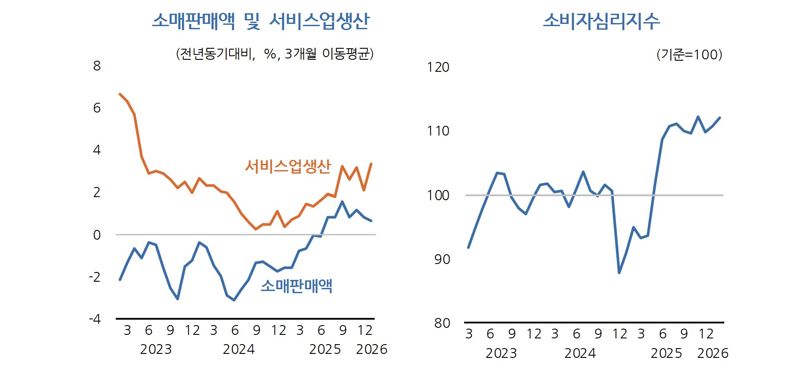
Meanwhile, as of January this year, both goods consumption and services consumption continued to grow at a modest pace. Retail sales in January rose 0.1% year-on-year, with the increase smaller than in December last year (1.3%). This was mainly due to the Lunar New Year holiday shifting from January last year to February this year. Excluding holiday effects and on a seasonally adjusted basis, retail sales in January increased 2.3% from the previous month, a larger gain than in December (0.6%). The consumer sentiment index in February stood at 112.1, higher than in January (110.8). Service-sector output in January grew 4.4% year-on-year, showing solid performance in most sectors, including finance and insurance (7.0%), wholesale and retail (5.8%), and health and social welfare (6.1%).
[email protected] Choi Yong-jun Reporter