U.S. turns to Trade Act Section 301 instead of reciprocal tariffs, targeting South Korea for "overproduction"
- Input
- 2026-03-12 11:03:45
- Updated
- 2026-03-12 11:03:45
[The Financial News] After losing its "reciprocal tariffs" tool in a Supreme Court of the United States (SCOTUS) ruling last month, the Trump administration has moved to introduce a new tariff mechanism by invoking Section 301 of the Trade Act of 1974 and has begun a preliminary investigation. The Trump administration argued that South Korea has consistently run a trade surplus with the U.S. in products such as electronics and automobiles, and pointed to the possibility of "overproduction."
16 economic entities targeted, including South Korea
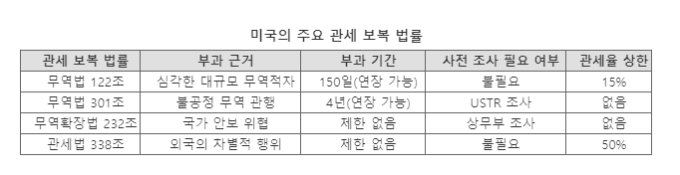
The Office of the United States Trade Representative (USTR) announced on its website on the 11th (local time) that it will investigate unfair trade practices by 15 countries—South Korea, People’s Republic of China (China), Japan, Singapore, Switzerland, Norway, Indonesia, Malaysia, Kingdom of Cambodia, Thailand, Vietnam, Taiwan, People’s Republic of Bangladesh, Mexico, and India—as well as the European Union (EU), based on Section 301 of the Trade Act of 1974. At a press briefing the same day, USTR representative Jamieson Greer said that several U.S. government agencies will form a "Section 301 Committee" and will accept written submissions from stakeholders from the 17th of this month through the 15th of next month. He added that a public hearing will be held on May 5, followed by a seven-day period for rebuttal comments. Greer stated that, after completing these procedures, the U.S. will consider various response measures, including tariffs and negotiations. Regarding the investigation period, he noted, "We are aware of the 150-day period," and said, "The goal is to reach a conclusion before the tariffs under Section 122 of the Trade Act of 1974 expire."Enacted in 1974, Section 301 of the Trade Act of 1974 authorizes the U.S. to retaliate—through import bans or additional tariffs—when a trading partner’s unfair systems or discriminatory practices harm U.S. companies. To trigger retaliatory measures, USTR must first conduct an investigation into unfair practices, which typically concludes within one year. A similar statute is Section 232 of the Trade Expansion Act of 1962 (Section 232). Section 232 can be invoked after an investigation by the United States Department of Commerce when specific imports are deemed to threaten U.S. national security. Neither statute sets time limits or caps on tariff rates for retaliatory duties.
In his announcement on the 11th, Greer suggested that the new move is intended to replace tariffs imposed under Section 122 of the Trade Act of 1974. After beginning its second term in February last year, the Trump administration used the International Emergency Economic Powers Act (IEEPA) between February and April to impose "Fentanyl" retaliatory tariffs and so-called "reciprocal tariffs." On the 20th of last month, however, SCOTUS ruled in a related case that imposing tariffs under IEEPA was unlawful.
In response, U.S. President Donald Trump signed a presidential proclamation the same day, imposing an additional 10% tariff on all imports under Section 122 of the Trade Act of 1974. That provision allows the U.S. president to levy tariffs of up to 15% on imports for 150 days to address a "serious balance-of-payments deficit." The current measure is set to expire on July 24.
South Korea flagged for "overproduction"; tariffs expected by late July
This is not the first time the U.S. has turned to Section 301 of the Trade Act of 1974. In 2018, during its first term, the Trump administration imposed retaliatory tariffs of up to 25% on imports from China, citing intellectual property violations and other concerns. The succeeding administration of U.S. President Joseph Robinette Biden Jr. also relied on Section 301 of the Trade Act of 1974 to impose a 100% tariff on Chinese electric vehicles and a 50% tariff on solar cells and related products.South Korea was targeted by "Super 301" between 1997 and 1998. Super 301 was a temporary measure under the Omnibus Foreign Trade and Competitiveness Act of 1988 that strengthened Section 301 of the Trade Act of 1974. Under that law, USTR could designate countries with unfair trade practices as a Priority Foreign Country (PFC) and conduct intensive negotiations before imposing retaliation. At the time, the U.S. cited barriers to automobile imports and designated South Korea as a PFC; the two countries eventually concluded negotiations after South Korea revised its automobile tax system. In 1996, the U.S. again designated South Korea as a PFC, arguing that the Korean government was intervening in private-sector purchases of telecommunications equipment.
In its website notice on the 11th, USTR specifically mentioned South Korea. USTR assessed that South Korea continues to run a trade surplus with the U.S., driven by exports of "electronic equipment, automobiles and auto parts, machinery, steel, and ships." It went on to note, "South Korea’s trade surplus expanded significantly in 2024 to reach 52 billion dollars (about 76 trillion won), up from a 10 billion dollar goods trade deficit in 2023." Regarding South Korea, USTR argued that "large or persistent trade surpluses provide evidence of structural overcapacity and overproduction," and claimed, "The South Korean government itself has acknowledged the need to reduce production capacity in the petrochemical sector."
At the briefing, Greer also addressed the reciprocal tariff agreements previously concluded with South Korea and other countries. He stated, "Those agreements remain in place. Under those agreements, our trading partners committed to lower tariff and non-tariff barriers, and the United States adjusted certain additional tariffs. Those agreements are still valid." However, Greer added that "a Section 301 of the Trade Act of 1974 investigation can lead to tariffs or other measures," signaling that additional duties could be imposed separately from the existing deals.
Greer further commented on the possibility of additional actions under Section 232 of the Trade Expansion Act of 1962 (Section 232), saying, "I do not expect new Section 232 measures in the next few weeks, but Section 232 investigations remain one of the options during this administration." He noted that, in addition, the U.S. could use Section 338 of the Tariff Act to impose retaliatory tariffs of up to 50% on countries that discriminate against U.S. products, although that provision is widely regarded as effectively dormant.
[email protected] Park Jong-won Reporter