Record Capital Outflows from Korean Stock Market: Foreign Investors Sold $13.5 Billion in February
- Input
- 2026-03-12 12:00:00
- Updated
- 2026-03-12 12:00:00
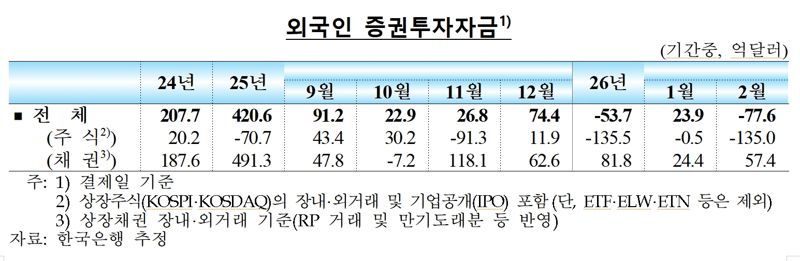
According to The Financial News, foreign investors recorded net sales of $13.5 billion in Korean stocks last month, marking the largest monthly capital outflow on record. As a result, foreign securities investment flows swung sharply to net outflows.
According to the "Trends in International Finance and the Foreign Exchange Market" for February 2026 released by the Bank of Korea (BOK) on the 12th, foreign investors’ domestic securities investment posted net outflows of $7.76 billion in February. This is the second-largest monthly net outflow since July 2008, when net outflows reached $8.97 billion.
Stock-related outflows were particularly pronounced. Foreign investors logged net sales of $13.5 billion in Korean equities last month, the largest monthly net outflow ever recorded. The previous record was in March 2020, when net outflows reached $11.04 billion.
The increase in foreign stock selling is seen as stemming from growing caution over Artificial Intelligence (AI) investments, combined with a sharp rise in domestic share prices that prompted profit-taking. In fact, the Korean stock market has continued its upward trend this year, keeping major indices at elevated levels.
In contrast, bond investment continued to see net inflows. Foreign bond investment expanded its net inflow on the back of bargain hunting triggered by rising market interest rates and solid investment demand, particularly from the private sector.
The shift in foreign capital flows also affected the exchange rate. The US Dollar–South Korean Won exchange rate rose due to the stronger United States dollar (USD) and foreign investors’ net selling of Korean stocks. The rate climbed from 1,439.5 won at the end of January to 1,469.2 won as of March 10, reflecting a weaker Korean won (KRW).
The BOK assessed that in global financial markets, investor sentiment has deteriorated and volatility has increased as geopolitical tensions persist, including the escalation of conflicts in the Middle East.
[email protected] Hong Ye-ji Reporter