It’s War, but Someone Is Smiling: U.S. Shale, EVs and Latin America Gain from the Turmoil
- Input
- 2026-03-12 15:36:06
- Updated
- 2026-03-12 15:36:06
According to U.S. media reports on the 11th (local time), a large refinery will be newly built in Texas, which holds the largest shale gas and oil reserves in the United States.
Donald Trump said on Truth Social that "for the first time in 50 years, a new refinery is being built in the United States," calling the project "the largest $300 billion deal in American history."
The refinery will be constructed at the Port of Brownsville in Texas and is scheduled to break ground in the second quarter of this year. The project is being financed by Reliance Group, led by Indian billionaire chairman Mukesh Dhirubhai Ambani.
Notably, the facility plans to use only U.S. shale oil as feedstock. Over 20 years, it is expected to process about 1.2 billion barrels of U.S. light shale oil and produce roughly 50 billion gallons (about 189.3 billion liters) of refined petroleum products over the same period.
Shortage of shale equipment: Is a new 'shale revolution' coming?
Soaring demand for Liquefied Natural Gas (LNG) is creating a shortage of hydraulic fracturing equipment needed to drill shale gas.Andy Hendricks, chief executive officer of Patterson-UTI Energy Inc., said, "We have essentially run out of capacity in our natural-gas-powered equipment," adding, "For the next two to three years, there will be strong demand for equipment in Haynesville Shale, one of the leading shale gas basins in the United States, and we will likely need to manufacture new units and ramp up operations in that region."
Shale oil and gas are extracted by injecting fluid at high pressure into underground shale formations to fracture the rock. In the 2010s, as international oil prices climbed, production of shale oil and gas surged in Texas and New Mexico, triggering what was dubbed the "shale revolution." However, as prices later stabilized, the industry slipped into a period of stagnation.
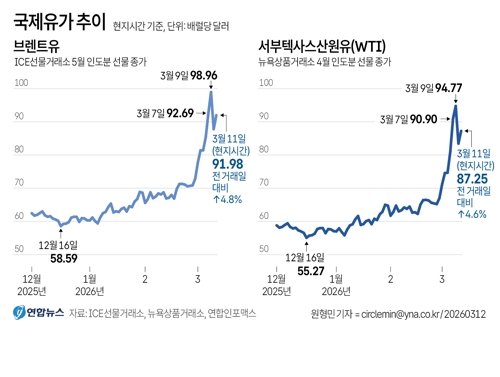
Recently, though, the heightened volatility in oil prices caused by the Iran war has sparked renewed moves to boost output. This trend also aligns with President Donald Trump’s policy stance. Throughout his election campaign, President Trump pledged to expand domestic oil and gas drilling, frequently rallying supporters with the slogan, "Drill, baby, drill."
Electric vehicle industry also buoyed by surging oil prices
Electric vehicle makers in California are quietly smiling as well.The war involving Iran has driven gasoline prices sharply higher, fueling expectations that demand will grow for electric vehicles, which are free from fuel-cost concerns.
The Los Angeles Times (LA Times) reported that "the average gasoline price in California has reached $5.20 per gallon," and cited experts who said that "this could lead to increased demand for electric vehicles."
Sam Abuelsamid, an analyst at Telemetry Agency, noted, "In early 2022, when oil prices topped $100 per barrel, electric vehicle sales in the United States began to rise in earnest," and predicted, "If gasoline prices remain elevated, the adoption of electric vehicles, particularly hybrids, is likely to increase."
Latin America’s strategic value rises on resources and geopolitical stability
Latin American countries such as Brazil and Guyana are also drawing attention as potential winners in a prolonged period of high oil prices.On the same day, Argentina-based outlet Infobae reported, citing a recent report by Goldman Sachs Group Inc., that "if oil prices remain high for an extended period, Latin America is seen as one of the few regions in the world where economic growth rates could actually accelerate."
The report assessed that "the region’s structure, with many net energy exporters, is Latin America’s greatest strength." It argued that if crude oil and energy prices rise, major oil producers such as Brazil, Guyana and Colombia are highly likely to enjoy both increased exports and greater foreign currency inflows.
The report also noted that "for countries like Mexico and Chile, which rely heavily on energy imports, the benefits may be more limited, but overall, higher commodity prices are expected to have a positive impact on the region’s economies."
Latin America’s strategic value is also increasing as a key supplier not only of oil and natural gas, but of critical raw materials such as copper, lithium and agricultural products.
In particular, the region is seen as increasingly attractive for investment amid the trend toward nearshoring, in which companies move production bases closer to home to shorten supply chains and enhance stability, given its geographic proximity to the United States.
Economists point out that Latin America’s distance from the world’s main conflict zones is another factor boosting its investment appeal. However, they also stress that to turn this opportunity into tangible growth, the region will need to expand intra-regional trade, integrate energy markets and build shared infrastructure.
[email protected] Hong Chae-wan Reporter