How long will the semiconductor boom last? BOK says, “At least through this year”
- Input
- 2026-03-12 12:00:00
- Updated
- 2026-03-12 12:00:00
In its March 2026 Monetary and Credit Policy Report released on the 12th, the BOK stated, "The current global semiconductor upcycle, which began in March 2023, is the strongest since the 2000s," adding, "At least through this year, semiconductor market conditions are expected to remain firm."
First, demand is expanding in a structural way. As the role of AI models advances from simple "learning" to "logical reasoning," demand is rising not only for high-performance semiconductors such as High Bandwidth Memory (HBM), which process massive amounts of data quickly, but also for memory semiconductors used to repeatedly store and retrieve training and generation results.
In particular, demand for HBM is surging as AI models evolve from text-based systems into multimodal models that handle video and audio simultaneously.
The scope of AI applications is also widening. With the spread of Physical Artificial Intelligence (Physical AI), which operates in physical environments such as autonomous vehicles and robots, and Agentic AI, which makes decisions autonomously, demand is increasing for low-power, customized chips alongside high-performance computing semiconductors.
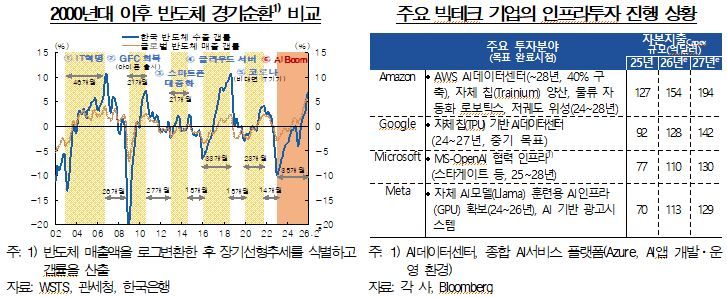
As a result, the current semiconductor market is tilted in favor of suppliers. With a growing share of custom high-performance chips and capacity expansion focused on qualitative upgrades, supply has not been able to keep up with demand, leading to excess demand. New plant construction and expansion are under way, but actual increases in supply are expected to materialize only gradually.
Lee analyzed, "As semiconductor companies strengthen the binding power of supply contracts and pursue production and inventory management strategies based on real demand, the ratio of inventories to sales at major chipmakers is likely to remain at a stable level."
However, she added, "There is also a possibility that demand volatility will increase due to adjustments in AI-related investment, technological shifts, or abrupt changes in the competitive landscape."
[email protected] Kim Tae-il Reporter