Inflation Risks Lurking Worldwide...BOK Warns of Growing Global Price Pressures
- Input
- 2026-03-12 12:00:00
- Updated
- 2026-03-12 12:00:00

In the March 2026 Monetary and Credit Policy Report released on the 12th, the Bank of Korea (BOK) identified three broad categories of inflationary drivers. On the demand side, stronger-than-expected growth in major economies and an expansionary fiscal stance were cited as key factors adding to global inflationary pressure.
Choi In-hyeop, Deputy Head of the Policy Analysis Team in the Monetary Policy Department at the Bank of Korea (BOK), stated, "When growth in advanced and emerging economies strengthens simultaneously, global inflationary pressures can increase further." He explained, "If concerns about fiscal soundness deepen due to additional spending in a situation where inflation expectations in major economies still exceed target levels and government debt remains high, this could fuel inflation expectations."
On the supply side, the report pointed to increased investment in Artificial Intelligence (AI) and rising prices of raw materials and intermediate goods stemming from heightened geopolitical risks, such as the recent turmoil in the Middle East. Choi noted, "Prices of semiconductors, natural gas and non-ferrous metals have been on a strong upward trend recently," adding, "International oil prices have surged due to instability in the Middle East, and if this persists, it will significantly intensify global inflationary pressures."
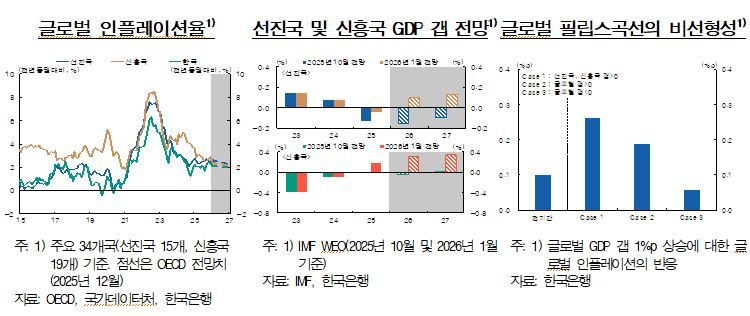
Choi further analyzed, "If the range of products subject to U.S. tariff policy is expanded or tariff rates are raised, inflationary pressures in the U.S. could intensify." He added, "This would heighten uncertainty around the Federal Reserve System (the Fed)'s monetary policy and trigger a stronger dollar, thereby acting as a factor that amplifies inflationary pressures in other countries."
The Bank of Korea (BOK) concluded that if these factors combine to strengthen inflation, the impact could be transmitted to domestic prices directly through higher import prices and indirectly via the exchange rate channel. Specifically, based on estimates of Korea’s Phillips curve that incorporate global inflation, the analysis showed that a 1 percentage point increase in global inflation leads to a 0.2 percentage point rise in domestic prices.
[email protected] Kim Tae-il Reporter