Trump Says “Markets Are Holding Up Well”... White House Believes Oil Prices Manageable for 3–4 Weeks
- Input
- 2026-03-12 06:26:50
- Updated
- 2026-03-12 06:26:50
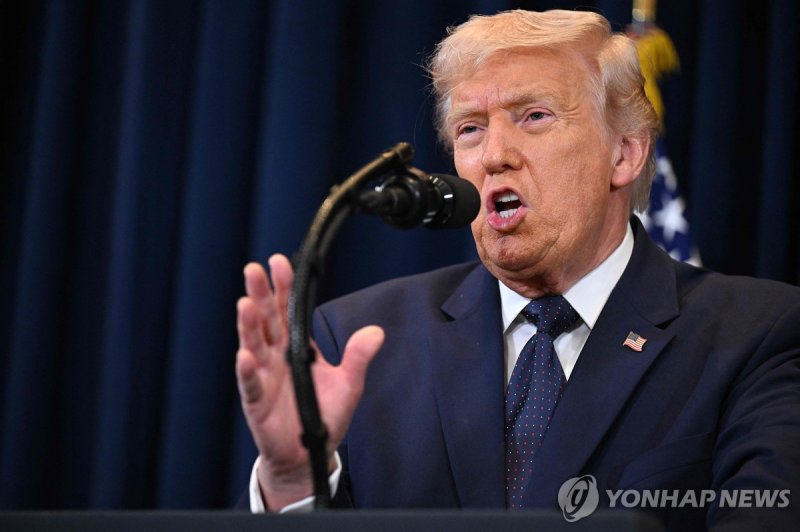
[Financial News] On the 11th (local time), United States of America (US) President Donald John Trump said that financial markets and oil prices are holding up stably despite the military clash with the Islamic Republic of Iran. Inside The White House, officials reportedly believe they have roughly three to four weeks before rising oil prices turn into a serious political liability.
During a visit that day to pharmaceutical company Thermo Fisher Scientific in Cincinnati in the U.S. state of Ohio, President Donald Trump said, "The markets are holding up well," adding, "We expected there would be some hit, but it was less than we thought."
He went on to say, "It will return to normal in a fairly short period of time," and added, "Prices are coming down sharply, and oil prices will go down as well."
President Trump also highlighted what he described as the success of the military operations against the Islamic Republic of Iran. He claimed, "We have taken down the Iranian leadership twice," and said, "We have twice broken their leadership, their navy, and every form of their military." He added, "Now they have new leadership in place," and remarked, "Let’s see what happens to them."
However, President Trump did not provide details on whether there had been any additional strikes on the leadership beyond the killing of Islamic Republic of Iran Supreme Leader Ayatollah Seyyed Ali Khamenei in the military campaign against the Islamic Republic of Iran, dubbed "Operation Epic Fury," which began on the 28th of last month.
President Trump referred to the current short military operation as an "excursion." He said, "This is an excursion that will get us out of war, and it will be a war for them."
Regarding the situation in the Strait of Hormuz, he stated, "So far we have attacked 28 ships used for laying mines."
Meanwhile, US political outlet Politico reported that The White House sees the period during which it can politically withstand higher oil prices as roughly three to four weeks.
A source close to The White House said, "We think we have about three to four weeks to take necessary measures before oil prices become a major political problem." The source added that if the main phase of the war ends early and the recovery trend in the economy continues, "the economy could maintain a recovery trajectory over the summer, from May through August."
A former official in the Trump administration noted, "Temporary price fluctuations are not a basis for policy decisions," explaining that if a policy shift is needed, officials must first observe a consistent trend in oil prices over several weeks.
So far, the Trump administration is not believed to have seriously considered revising its military strategy against the Islamic Republic of Iran solely because of rising oil prices. However, when international oil prices surged over the weekend, there was reportedly considerable tension inside The White House.
Another source close to The White House said that officials there were deeply alarmed on the night of the 8th by the spike in oil prices. After President Trump then made comments hinting at the possibility of an early end to the war, international oil prices, which had been nearing 120 dollars per barrel, fell immediately.
International oil prices later dropped to around 80 dollars per barrel, and within The White House the view reportedly spread that the price spike was temporary and at a manageable level.
Taylor Rogers of The White House press office said, "Once the military objectives are achieved and the Iranian regime is neutralized, oil prices will fall quickly," adding, "American households will benefit in the long run."
Public opinion in the US, however, shows significant concern about rising oil prices. In a poll conducted by Quinnipiac University from the 6th to the 8th, 49% of respondents said they were very worried about higher oil prices and 25% said they were somewhat worried. In total, 74% of respondents expressed concern about rising oil prices.
When asked how long the US military campaign against the Islamic Republic of Iran would continue, the largest share of respondents, 32%, answered "a few months." Another 26% said "more than a year," and 13% said "about a year." Only 18% expected it to last "a few weeks."
Against this backdrop, President Trump’s repeated emphasis on battlefield gains and the possibility of an early end to the war is seen as a strategy to manage both market jitters and public anxiety. In an interview the same day with online outlet Axios, President Trump also asserted, "The war with the Islamic Republic of Iran will end soon," adding, "It will end when I want it to end."
[email protected] Reporter Kim Kyung-min Reporter