Monetary Policy Board Member Hwang Geon-il: "Monetary policy should remain neutral for the time being"
- Input
- 2026-03-12 12:00:00
- Updated
- 2026-03-12 12:00:00
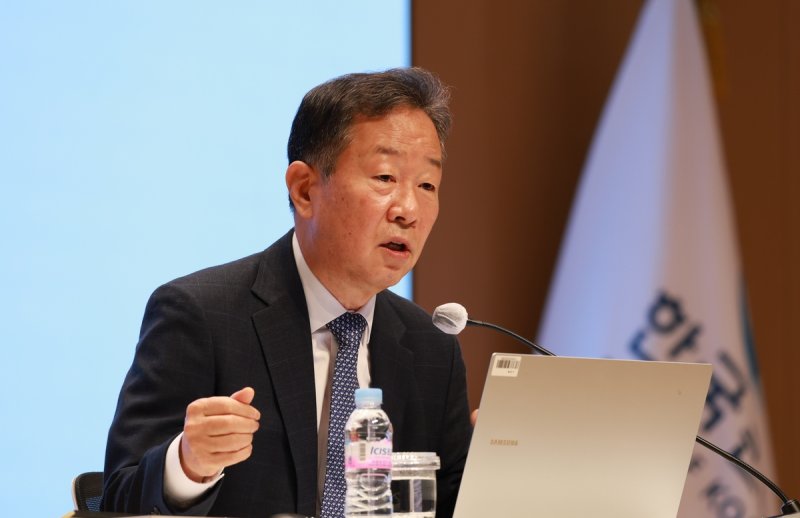
In the "March 2026 Monetary and Credit Policy Report" released on the 12th, Board member Hwang delivered the lead message: "Rather than shaping expectations in a particular direction, it would be desirable for monetary policy to maintain a cautious and neutral stance for the time being, while monitoring changes in domestic and external conditions and economic indicators."
In effect, it will be difficult to adjust the base rate. A premature rate cut could fuel inflation pressures that are emerging amid a sharp rise in global oil prices, while a rate hike would increase the burden on borrowers who have taken out loans to purchase housing.
The Monetary Policy Board of the Bank of Korea (Monetary Policy Board) kept the base rate unchanged at 2.50% at last month’s meeting. The rate was lowered to 2.50% in May last year and has since been held there for six consecutive meetings. As a result, this level will have been maintained for a full year by the April meeting of the Monetary Policy Board.
He pointed to the geopolitical instability triggered by the airstrikes carried out by the U.S. and Israel against the Islamic Republic of Iran on the 28th of last month (local time) as a key factor behind his view.
Hwang said, "Since March, the rapid shift in external conditions due to conflicts in the Middle East has greatly increased uncertainty around the projected path, and volatility in financial and foreign exchange markets has also expanded significantly." He judged that "going forward, the paths of inflation and growth will be heavily influenced by developments in the Middle East, in addition to changes in U.S. tariff policy, monetary and fiscal policies in major economies, and the semiconductor cycle."
He went on to say, "From the perspective of financial stability, interest rates and the exchange rate are showing high volatility as they deviate from economic fundamentals due to Middle East–related risks, so it will be necessary to respond actively, if needed, through market-stabilizing measures." He added, "As for housing prices, there are still risk factors, such as the upward trend spreading to areas outside the Seoul metropolitan area, so we must also examine whether prices are stabilizing in a sustained manner."
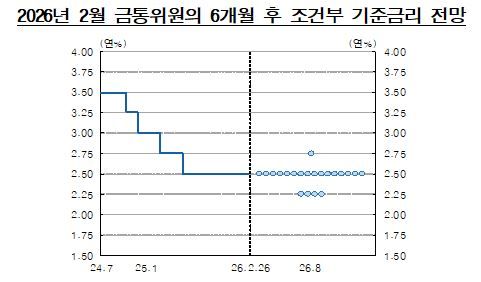
Starting with the Monetary Policy Board’s meeting on the monetary policy stance that day, the BOK extended the horizon of its forward guidance from three months to six months and introduced a dot plot when presenting it. All seven members of the Monetary Policy Board, including the governor, each placed three dots (21 in total) to indicate their projections for the level of the policy rate over the next six months. They may place two dots at one level and one at another, three dots at the same level, or all three at different levels.
[email protected] Kim Tae-il Reporter