[Unboxing Lab] "A stretchy semiconductor?"... New e-skin stays fully functional even when stretched to three times its length
- Input
- 2026-03-12 05:56:00
- Updated
- 2026-03-12 05:56:00
Do you remember the thrill of opening a package delivery box? In university labs, discoveries that could transform our lives are being made at this very moment. They are just wrapped in a thick layer of "academic papers." In Unboxing Lab, we skip the complicated formulas and theories and pull out only the core ideas you actually want to know. So, shall we open the box? Today’s unboxing star is this research.
■ The era of highly stretchable electronic skin
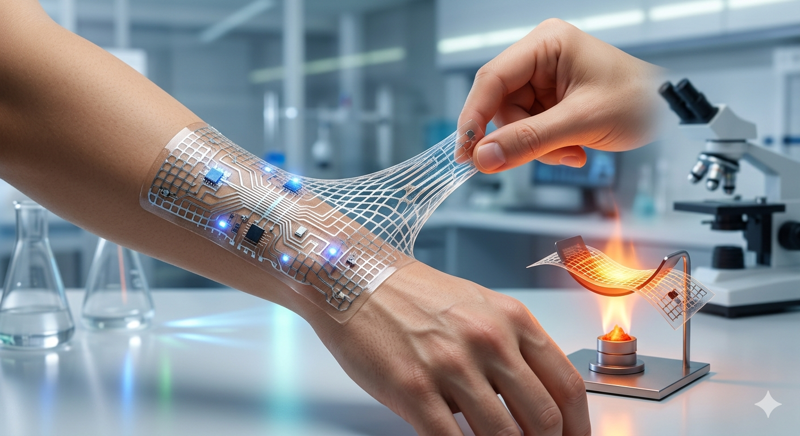
This research brings us one step closer to making electronic skin (e-skin), once seen only in movies, a reality. Conventional semiconductors are rigid, and even a small amount of stretching can break the electrical pathways and drastically degrade performance. In contrast, the newly developed material stably maintains its electrical performance even when stretched more than 300% beyond its original length. In other words, a 10 cm strip can be pulled out to 40 cm without any loss in performance.
The potential applications are vast. It could be used in medical patches that attach directly to the skin and monitor health in real time, or as the neural network for a soft robot that moves using flexible materials instead of rigid metal. Its strong heat resistance is especially important, as it allows safe, error-free operation even in hot conditions encountered in everyday life.
■ Molecular design stacked like LEGO bricks
To achieve this striking result, the researchers designed a special structure called a multiblock copolymer. They tightly linked, at the molecular level, a "hard block" of Poly(3-hexylthiophene) (P3HT), which conducts electricity well, with a "soft block" of Polydimethylsiloxane (PDMS), which has rubber-like stretchability.
The key to this process was a technique known as living polymerization. It allowed the team to control molecular chain length freely, much like stacking LEGO bricks one by one with precision. By tuning the balance between the two components using this method, they succeeded in preventing the electrical pathways from twisting or breaking, even when the material was stretched to its limits.
■ Performance that survives a 300°C inferno
The experimental results are backed by numbers. Even when the material was stretched by 300%, not even microscopic cracks appeared on its surface. Its charge carrier mobility, a measure of how efficiently electricity flows, remained at the same top score as before stretching.
Unlike typical flexible materials, which often melt at temperatures just above 100°C, this material retained its semiconductor properties even after heat treatment at a scorching 300°C. That is far hotter than frying oil, and it shows that the material can easily withstand the harsh thermal conditions of complex semiconductor manufacturing processes.
This research has been published in Angewandte Chemie, a leading international journal in the field of chemistry, underscoring its excellence.
That’s it for today’s unboxing. The day is not far off when rigid semiconductors will transform into soft, rubber-like materials and become part of our own bodies.
[email protected] Reporter Kim Man-gi Reporter