Forced Liquidations on Debt-Fueled Stock Bets Triple... Retail Investors on Edge [U.S.–Iran War]
- Input
- 2026-03-11 18:22:30
- Updated
- 2026-03-11 18:22:30
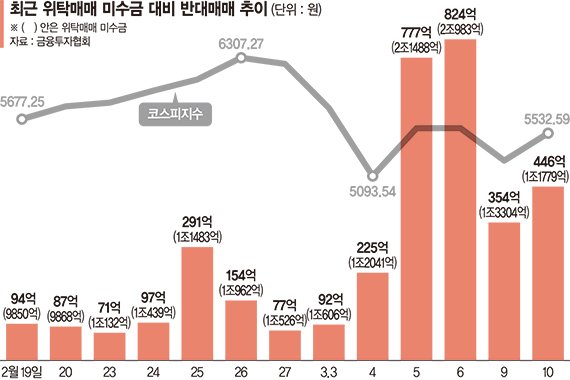
According to the Korea Financial Investment Association (KOFIA) on the 11th, the actual amount of forced liquidations in relation to brokerage margin trades averaged 45.3 billion won per day this month through the previous day. That is three times the previous month’s daily average of 13.5 billion won, and about six times last year’s daily average of 7.1 billion won.
Analysts say forced liquidations have surged because more retail investors, who increased leverage to ride the market rally, have been unable to repay their obligations after the recent sharp downturn.
The Korea Composite Stock Price Index (KOSPI) plunged 7.24% on the 3rd and another 12.06% on the 4th following airstrikes by the United States of America (U.S.) on the Islamic Republic of Iran. The index then rebounded 9.63% on the 5th, only to tumble 5.96% on the 9th amid concerns over rising oil prices. On the 10th, it jumped 5.35% as oil prices pulled back, extending the roller-coaster pattern.
Given the high level of unpaid margin balances, forced liquidations could continue to pour out. This month, outstanding margin receivables from brokerage trades have at times exceeded 2 trillion won. They reached 2.1488 trillion won on the 5th and 2.0983 trillion won on the 6th, marking two consecutive days above 2 trillion won. This is the highest level since February 2006, when such balances last ballooned.
These margin transactions allow individual investors to borrow from brokerages to buy stocks and then repay the amount within two trading days, effectively an ultra-short-term credit purchase. If investors fail to pay for stocks bought on margin by the settlement deadline, brokerages forcibly sell those shares through forced liquidation to recover the funds they lent.
KOFIA only compiles data on forced liquidations related to these margin transactions. If forced liquidations from regular margin loans were included, the total scale would likely be much larger. Margin loans refer to funds investors borrow from brokerages to buy stocks and have yet to repay. Because the purchased shares serve as collateral, brokerages can forcibly dispose of them if a price drop erodes the collateral value.
Outstanding margin loan balances first surpassed 30 trillion won on January 29 and have continued to climb. On the 5th, they hit a fresh record of 33.6945 trillion won.
Forced liquidations typically occur at prices below prevailing market levels, so investors face not only the risk of failing to repay their loans but also significant principal losses. In addition, when forced selling increases, a flood of low-priced shares can widen downside volatility in stock prices.
Ko Gyeong-beom, an analyst at Yuanta Securities Korea, said, "When the index plunges, outstanding margin loan balances can become a burden on market supply and demand," adding, "Recently, unpaid margin balances on brokerage trades have surged, and there are also risks stemming from forced liquidations."
With risks from the Middle East still unresolved, many expect a volatile market to persist for the time being. Some analysts also argue that the massive inflow of retail money is further amplifying these price swings.
Kwon Soon-ho, an analyst at Daishin Securities, noted, "The recent influx of funds into the stock market appears to be geared more toward short-term trading than long-term investment," and assessed, "This funding structure, combined with herd behavior, is driving greater volatility."
He went on to say, "The magnitude of the market’s decline and its volatility are driven less by deteriorating fundamentals and more by an overreaction rooted in herd behavior, where fear and bargain-hunting sentiment collide," adding, "If investors can tolerate the volatility, they may be able to achieve relatively solid returns in the semiconductor sector, where earnings forecasts remain robust, and in consumer staples stocks that have seen steeper declines."
Eun Taek Lee, an analyst at KB Securities, predicted, "Given the resilience of the U.S. stock market in recent sessions, the likelihood that Big Tech will halt investments in artificial intelligence (AI) because of the Iran situation is very low."
[email protected] Reporter Seo Min-ji Reporter