Financial Regulators Prepare for Prolonged Middle East Crisis, Consider Expanding 100 Trillion Won Bond Stabilization Program [U.S.–Iran War]
- Input
- 2026-03-11 18:22:28
- Updated
- 2026-03-11 18:22:28
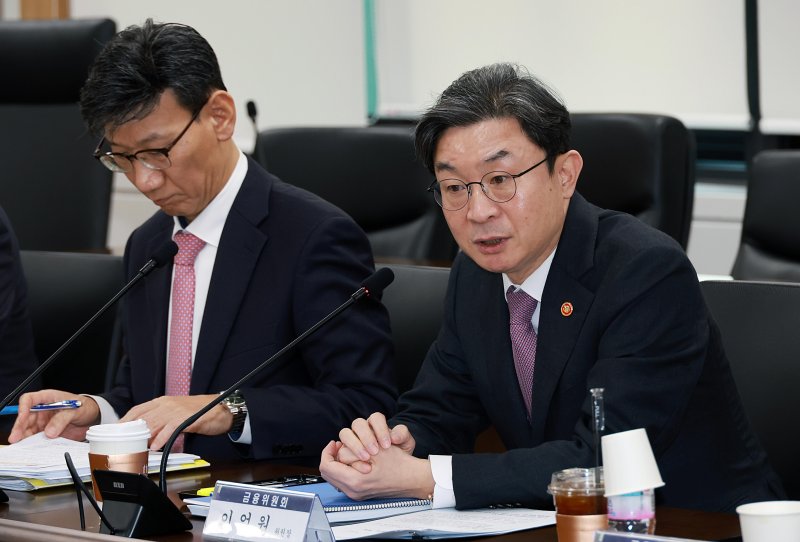
On the 11th, the Financial Services Commission (FSC) held a "Financial Market Risk Review Meeting" chaired by Lee Eog-weon. The Financial Supervisory Service (FSS), research institutes, and market experts attended the meeting, where participants discussed these measures.
Lee assessed that, unlike past episodes, the current Middle East crisis is marked by such high uncertainty that it is difficult to predict how events will unfold, and that the risk of disruptions to the global energy supply chain is also significant. He instructed officials to conduct scenario-based stress tests that assume even worst-case outcomes, including a prolonged conflict in the region, and to comprehensively analyze and review the impact and risk factors by market segment, financial sector, and industry. He emphasized that it is crucial to identify the "weak links" in the financial system, such as vulnerable financial sectors and high-risk financial products that could be hit hard by external shocks.
Although the recent surge in oil prices and the exchange rate eased on the day, market anxiety over the possibility of a drawn-out Middle East crisis remains high. For now, the impact on the financial sector as a whole appears limited, but there are concerns that if volatility in exchange rates and oil prices widens, the risks to the financial market could grow.
According to credit rating agency NICE Investors Service, the foreign-currency assets of major commercial banks — including KB Kookmin Bank, Shinhan Bank, Hana Bank, Woori Bank, Standard Chartered Bank Korea, Citibank Korea, and iM Bank — totaled 303.7 trillion won as of the third quarter of last year, accounting for 13.0% of their combined total assets.
Some analysts warn that if the value of the U.S. dollar continues to rise and the won-denominated value of foreign-currency assets increases, risk-weighted assets (RWA) could grow and undermine banks’ soundness. They also note that if exchange-rate volatility forces banks to post additional margin on foreign-exchange derivatives, their foreign currency Liquidity Coverage Ratio (foreign currency LCR) could decline.
The Financial Supervisory Service (FSS) also summoned vice presidents in charge of foreign-currency funding at major domestic banks on the same day, urging them to secure sufficient foreign-currency liquidity. The FSS decided to shorten the frequency of foreign-currency liquidity stress tests from once a quarter to once a month, and to continuously monitor banks’ foreign-currency funding and investment conditions through a hotline with the banking sector.
Meanwhile, the FSC, together with Korea Development Bank (KDB), Industrial Bank of Korea (IBK), and Korea Credit Guarantee Fund (KODIT), plans to swiftly draw up measures to further expand the 100 Trillion Won Plus Alpha Market Stabilization Program, which is currently purchasing corporate bonds and commercial paper (CP) to stabilize the bond and money markets, depending on market conditions.
[email protected] Lee Joo-mi Reporter