Household loans rose 2.9 trillion won last month as shift to non-bank lenders continues
- Input
- 2026-03-11 18:21:22
- Updated
- 2026-03-11 18:21:22
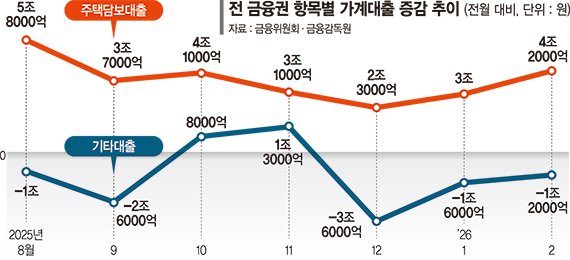
According to the report "Trends in Household Loans in February 2026" released on the 11th by the Financial Services Commission (FSC) and the Financial Supervisory Service (FSS), total household loans across all financial institutions rose by a provisional 2.9 trillion won from the previous month. After shrinking by 1.2 trillion won in December last year, the balance rebounded by 1.4 trillion won in January and then expanded further in February.
Banks appear to have moved into tighter loan management. In February, household loans at banks fell by 300 billion won from a month earlier. The decline was smaller than in January, when balances dropped by 1 trillion won, but the downward trend continued. Bank-originated mortgage loans kept shrinking, from a 1.7 trillion won decrease to a 1.1 trillion won decrease, while policy loans such as Didimdol, Bogeumjari and other government-backed mortgages saw their increase widen from 1.1 trillion won to 1.5 trillion won.
Park Min-cheol, head of the Market Management Team at the Financial Markets Department of the Bank of Korea (BOK), said, "Government policies are helping to reverse the one-way upward expectations that had formed around housing prices," adding, "We are seeing more apartments being put up for sale in the greater Seoul area, and in some parts of Seoul’s Gangnam district, prices have started to turn downward, indicating a slowdown in the previous uptrend."
However, he noted, "Last year we saw the upward trend in prices ease and then pick up again, so we need to watch carefully to see whether this current pattern will continue as a lasting trend."
Household loans at non-bank financial institutions increased by 3.3 trillion won. Combined with the 2.5 trillion won rise in January, they have grown by 5.7 trillion won so far this year, already exceeding last year’s full-year net increase of 4.9 trillion won by 800 billion won. Mutual finance institutions saw their increase expand from 2.3 trillion won to 3.1 trillion won, while insurance companies shifted from a 200 billion won decline to a 200 billion won increase, and credit card and finance companies from a 10 billion won rise to a 100 billion won rise.
An FSC official stated, "In February, household loans increased overall even though bank-originated mortgages fell for a third consecutive month, because policy loans and household lending by non-bank institutions expanded in scale." The official assessed, "This was driven by seasonal factors such as moving demand at the start of the school term, as well as continued growth in group loans centered on mutual finance institutions like the National Agricultural Cooperative Federation (NACF) and the Korean Federation of Community Credit Cooperatives, and other non-bank lenders."
The official went on to emphasize, "In March, demand for mortgage loans could increase due to a rise in properties being put up for sale ahead of the end of the temporary easing of capital gains tax surcharges on multi-home owners on May 9. Under a consistent stance of managing household debt, it will be necessary to closely monitor regional housing market conditions and household loan trends."
Other household loans in February fell by 1.2 trillion won from the previous month. The decline, however, was smaller than in December last year, when they dropped by 3.6 trillion won, and in January, when they fell by 1.6 trillion won. Despite inflows from holiday and performance bonuses, demand for domestic and overseas stock investments meant the decrease was not as large as in typical years.
Corporate loans by banks increased by 9.6 trillion won, bringing the outstanding balance to 1,379.2 trillion won. Combined with the 5.7 trillion won rise in January, bank corporate lending has grown by 15.3 trillion won so far this year.
Loans to large corporations climbed from a 3.4 trillion won increase to a 5.2 trillion won increase, as banks pursued loan expansion strategies and demand for working capital, including holiday-related funds, rose. Loans to small and medium-sized enterprises expanded from a 2.3 trillion won increase to a 4.3 trillion won increase, nearly doubling, driven by banks’ efforts to boost sales, strengthen inclusive finance, and meet funding needs around the Lunar New Year holidays.
[email protected] Kim Tae-il and Park Moon-su Reporter